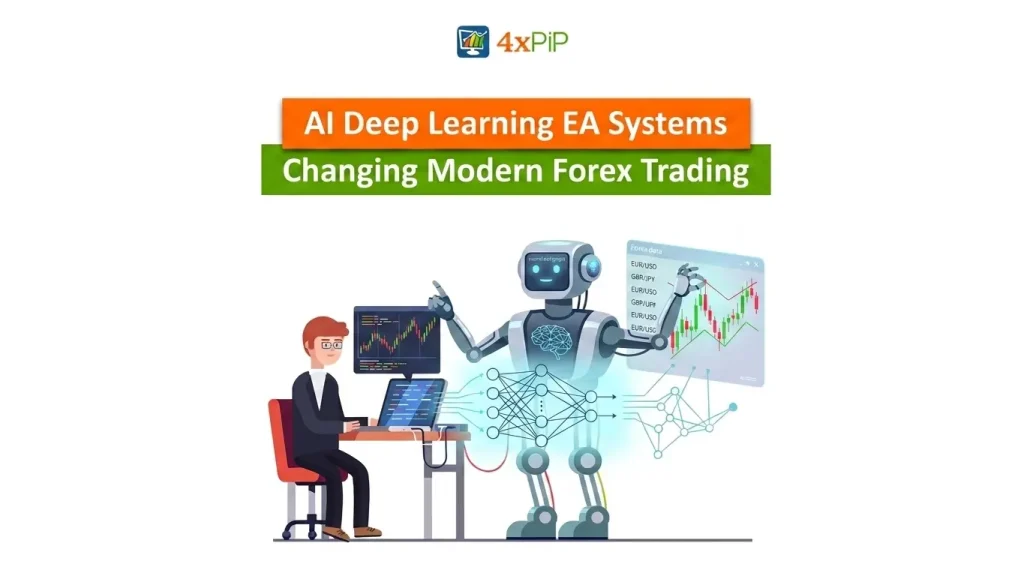
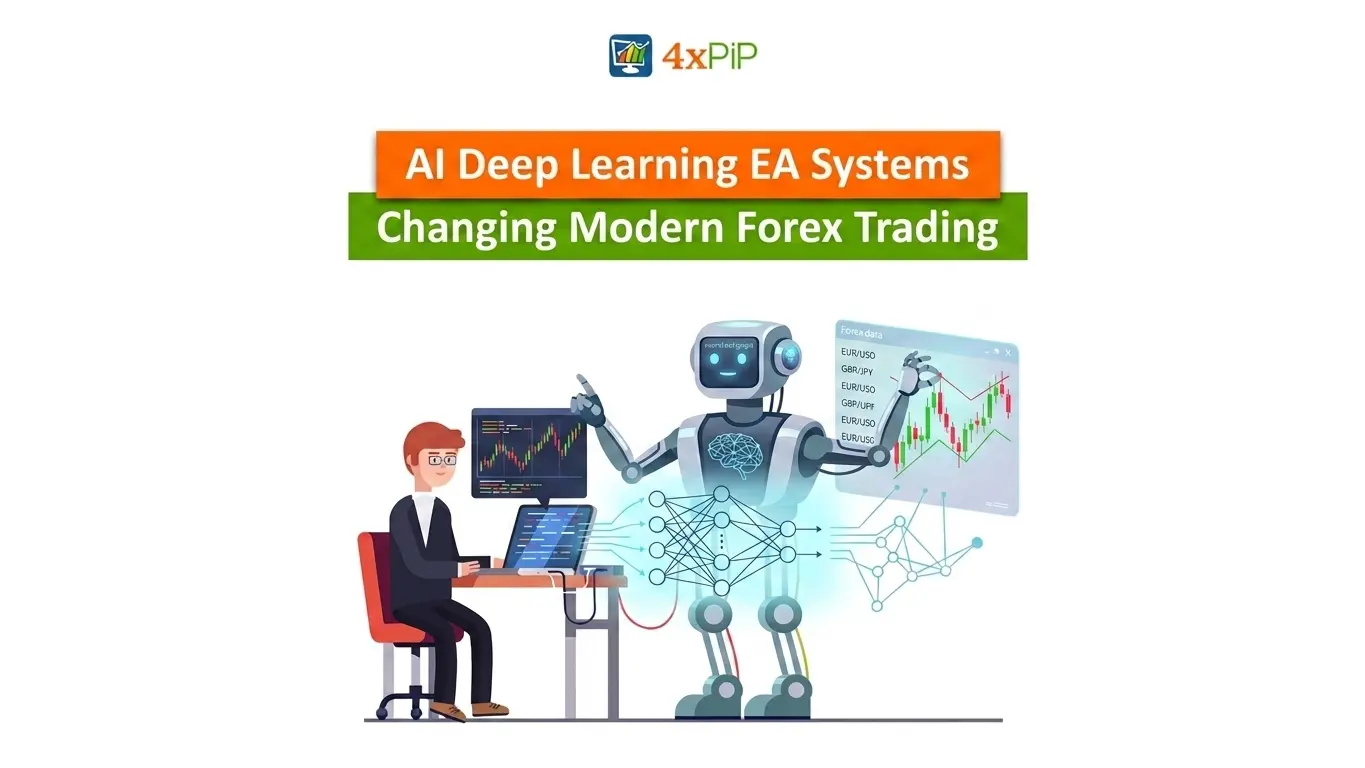
AI Deep Learning EA systems are advanced automated trading programs designed for Forex trading automation using neural networks and large historical datasets. These systems analyze market behavior through Machine Learning (ML), Deep Learning (DL), and Reinforcement Learning (RL), processing 10+ years of candlestick data, technical indicators, and news-driven market events to generate precise Buy and Sell decisions.
Unlike traditional Expert Advisors that rely on fixed rule-based logic, AI deep learning EA systems adapt to changing market conditions through continuous retraining and pattern recognition. This shift toward automation is driven by the need for faster execution, higher data complexity handling, and reduced human uncertainty in trading decisions. At 4xPip, we engineer AI MQL EA systems that evolve with new market data, allowing more data-driven decision-making in modern forex trading where speed and accuracy are important.
What AI Deep Learning EA Systems Are and How They Work
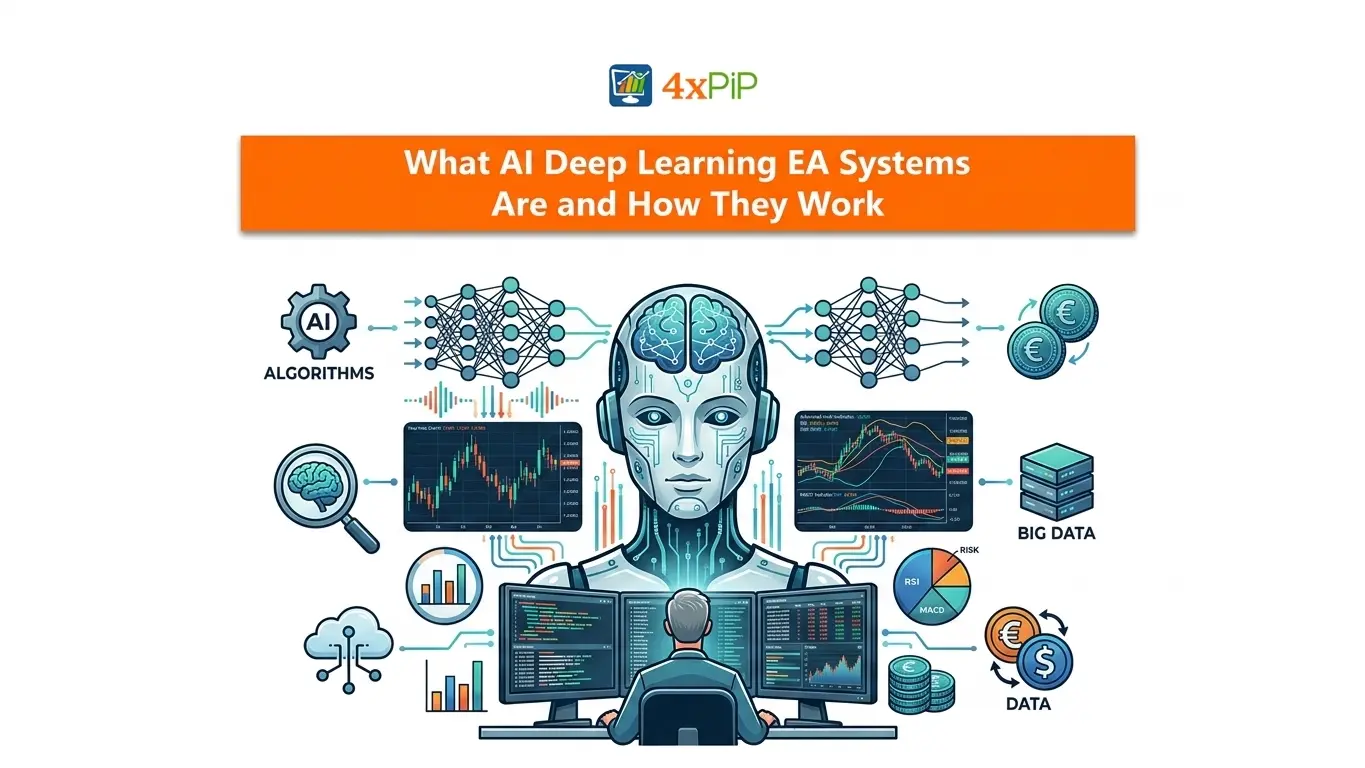
AI Deep Learning EA systems are built on layered neural network architectures that process trading data through interconnected mathematical nodes. In 4xPip’s AI EAs, the team designs these neural networks to learn from inputs such as OHLCV price data, technical indicators, and market volatility features. Each layer transforms raw market inputs into deeper feature representations, enabling the EA to detect patterns like trends, reversals, and breakouts directly inside MetaTrader (MT4/MT5).
These systems process both historical and real-time Forex data by continuously analyzing 10+ years of candlestick history combined with live market feeds. The model identifies recurring formations using Machine Learning (ML), Deep Learning (DL), and Reinforcement Learning (RL), while also integrating RSI, MACD, and other indicators for confirmation. In 4xPip AI MQL EA systems, this processed data is used to generate trade signals and automatically execute Buy or Sell actions without manual input, ensuring fully automated strategy execution based on learned market behavior.
Evolution from Traditional Expert Advisors to AI-Based Systems
Traditional Expert Advisors operate on fixed rule-based logic, where the Strategy is manually coded by the programmer and executed inside MetaTrader. In contrast, the AI based EA trading robot developed by 4xPip learns directly from 10+ years of historical market data, using Machine Learning (ML), Deep Learning (DL), and Reinforcement Learning (RL) to dynamically adjust trading decisions. Instead of static conditions, the EA evaluates candlestick patterns, indicators, and volatility structures to refine its decision-making model over time.
Traditional EAs often struggle when market volatility shifts, since fixed rules cannot adapt to sudden regime changes such as breakouts or news-driven spikes. The AI system addresses this limitation by continuously retraining on new market data, allowing it to adjust SL and TP logic based on evolving price behavior. Within 4xPip AI MQL EA development, this adaptive structure reduces reliance on manually coded strategies and enables more data-driven execution of Buy and Sell decisions across changing Forex market conditions.
Data Processing and Market Analysis in Deep Learning Trading Models
Deep learning trading models use large datasets built from price action, OHLCV, volume, timestamps, and technical indicators to train the Bot. Our AI based EA trading robot learns from candlestick patterns, RSI, MACD, ATR, and other market features so the model can separate real trading signals from noise and map out trend, reversal, and breakout conditions more accurately.
Once the model is trained, it keeps refining predictions with fresh market data as new candles form. This continuous retraining helps the AI MetaTrader EA stay aligned with current volatility and improves Buy, Sell, Stop Loss, and Take Profit decisions without manual intervention, which is exactly where our 4xPip AI based EA trading bot adds strong value for modern Forex automation.
Execution Speed, Automation, and Real-Time Decision Making
AI EAs execute trades far faster than human traders because the Bot processes price updates, indicator values, and market changes in real time. In unstable conditions, that speed matters because 4xPip AI based EA can react to fast swings, calculate entry and exit points, and place orders without delay, which helps keep trade execution aligned with live market movement.
Lower latency improves precision by reducing slippage and tightening the gap between signal and order placement. It also removes emotional decision-making, so the Strategy stays consistent even during sudden news events or sharp reversals. With 4xPip, this gives us a clean automated flow inside MetaTrader, where decisions are based on data instead of hesitation, fear, or overreaction.
Risk Management and Adaptive Learning Mechanisms
AI systems adjust risk dynamically by recalculating lot size, Stop Loss (SL), and Take Profit (TP) based on volatility, market structure, and the underlying Strategy. The 4xPip AI based EA continuously adapts these values using live market inputs, ensuring trade execution stays aligned with changing price conditions instead of relying on static risk rules.
Key adaptive mechanisms include:
- Lot size scaling based on current market volatility and account risk profile
- Dynamic SL/TP placement using historical price behavior and indicator signals
- Continuous adjustment as new candle data and market conditions appear
Reinforcement Learning improves this further through feedback loops. When a trade produces profit, the system reinforces that decision pattern; when it results in a loss, it reduces exposure to similar setups and shifts behavior over time. This allows the model to evolve its decision-making instead of repeating fixed logic.
However, even advanced AI models face limitations such as overfitting, where performance becomes too optimized on historical data and weaker in live conditions. That’s why controlled risk parameters remain essential. 4xPip maintains this balance by training across diverse datasets and keeping execution safeguards in place, ensuring the AI remains adaptive while still stable in real market environments.
Challenges, Limitations, and Real-World Performance Considerations
AI trading models perform strongly in demo, but real-world markets introduce challenges like overfitting and weak generalization. Even with historical training data, an AI Based EA trading robot can still misinterpret rare patterns if market behavior shifts beyond learned distributions. That is why Strategy design and dataset diversity remain important in ensuring the Expert Advisor performs consistently across all currency pairs, timeframes, and conditions.
Unexpected market shocks such as geopolitical events, central bank surprises, or liquidity crashes can temporarily disrupt even the most advanced predictions. In these situations, continuous monitoring and model updates become essential. 4xPip’s AI based bot supports ongoing refinement of AI models, combining automated learning with controlled oversight so the EA remains stable, adaptive, and aligned with real-time market behavior.
Summary
AI Deep Learning EA systems are advanced Forex trading automation tools that use Machine Learning (ML), Deep Learning (DL), and Reinforcement Learning (RL) to analyze large volumes of historical and real-time market data. Unlike traditional Expert Advisors that rely on fixed rule-based strategies, these AI-driven systems adapt dynamically to changing market conditions by learning from patterns in price action, indicators, and market volatility. They process extensive datasets, including 10+ years of candlestick history, to generate more refined Buy and Sell signals with reduced human uncertainty and improved decision-making speed.
These systems operate through layered neural networks that continuously refine trading logic as new data becomes available. They enhance execution speed, reduce latency, and improve trade precision by reacting instantly to market changes inside platforms like MetaTrader. In addition, adaptive risk management techniques such as dynamic Stop Loss, Take Profit adjustments, and volatility-based lot sizing help improve overall trade stability. However, despite their strengths, challenges such as overfitting, data uncertainty \, and unpredictable market shocks still require continuous monitoring and model refinement to maintain consistent real-world performance.
4xPip Email Address: [email protected]
4xPip Telegram: https://t.me/pip_4x
4xPip Whatsapp: https://api.whatsapp.com/send/?phone=18382131588
FAQs
- What is an AI Deep Learning EA system in Forex trading?
An AI Deep Learning EA system is an automated trading program that uses neural networks and advanced learning models to analyze Forex market data. It processes historical and real-time information to generate trade decisions without human intervention. - How is it different from a traditional Expert Advisor?
Traditional Expert Advisors follow fixed, rule-based strategies, while AI Deep Learning EAs learn from market data and adapt over time. This allows them to adjust to changing market conditions instead of relying on static logic. - What types of data do these systems use?
These systems use OHLCV data, candlestick history, technical indicators like RSI and MACD, and sometimes news-related market signals. They may also analyze over a decade of historical Forex data for training. - How do AI EAs generate trading signals?
They use layered neural networks to identify patterns such as trends, reversals, and breakouts. After processing multiple indicators and price structures, the system produces Buy or Sell signals based on learned behavior. - Can AI EAs adapt to changing market conditions?
Yes, they continuously retrain using new market data, allowing them to adjust to volatility shifts, breakouts, and evolving price patterns. This makes them more flexible than fixed-rule systems. - How fast do AI-based trading systems execute trades?
AI EAs execute trades in real time with very low latency. They react instantly to market changes, reducing delays between signal generation and order execution. - How is risk managed in AI Deep Learning EAs?
Risk is managed dynamically using volatility-based lot sizing, adaptive Stop Loss (SL), and Take Profit (TP) adjustments. The system continuously updates these parameters based on live market conditions. - What role does reinforcement learning play in these systems?
Reinforcement learning helps the system improve over time by rewarding profitable trade patterns and reducing exposure to losing setups. This feedback loop strengthens decision-making accuracy. - What are the limitations of AI trading systems?
Key limitations include overfitting, data uncertainty, and difficulty handling unexpected market shocks like geopolitical events or sudden liquidity changes. These factors can impact real-world performance. - Are AI Deep Learning EAs fully reliable for live trading?
They are highly advanced but not perfect. While they improve automation and decision-making, continuous monitoring, updates, and controlled risk management are still essential for stable performance.