AI Reinforcement Learning (RL) Expert Advisors are transforming how automated trading systems operate in Forex, Gold, Crypto, and index markets. Unlike traditional rule-based bots that rely on fixed conditions, an AI based EA trading robot learns from historical market behavior, candlestick patterns, technical indicators, and live trading outcomes to improve decision-making over time. At 4xPip, we develop AI Expert Advisors for MetaTrader (MT4/MT5) using Machine Learning (ML), Deep Learning (DL), and Reinforcement Learning (RL) models trained on 10+ years of historical market data to build adaptive and data-driven trading strategies.
Continuous learning is one of the biggest advantages of Reinforcement Learning in algorithmic trading. Instead of repeating static rules, RL-based trading bots analyze profit, loss, volatility, news events, and market structure changes to refine future trade entries and exits automatically. This allows the Expert Advisor to adapt to trending, ranging, breakout, and reversal market conditions with greater accuracy. At 4xPip, our programmers train AI EAs using advanced models like LSTM, PPO, DQN, and Actor-Critic algorithms so traders and EA owners can deploy smarter automated systems capable of faster execution, intelligent Stop Loss (SL) and Take Profit (TP) optimization, and real-time market adaptation.
The Core Structure of AI Reinforcement Learning Trading Bots
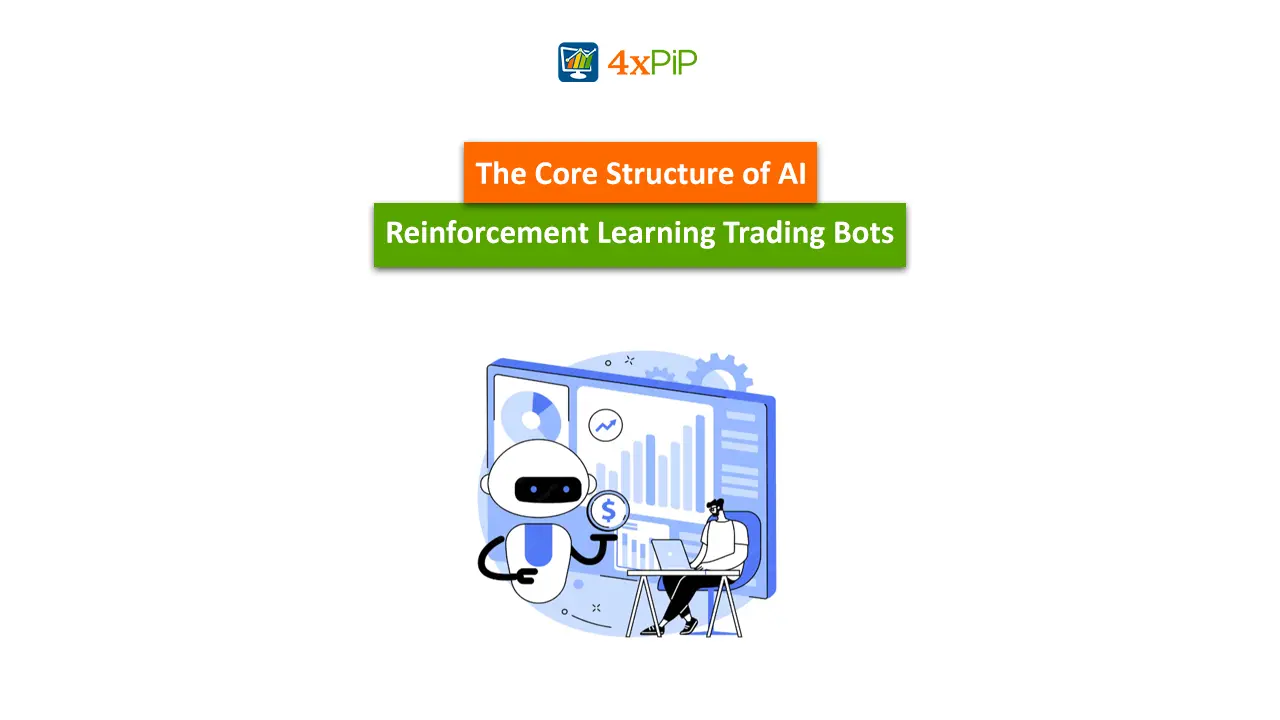
Reinforcement Learning trading bots are built around a loop where an agent (AI based EA trading robot) interacts with a market environment and learns from outcomes. At 4xPip, these systems are designed for MetaTrader (MT4/MT5) so the Expert Advisor can continuously improve decision-making instead of relying on fixed rule-based logic.
Core RL structure includes:
- Agent: The trading bot that executes Buy, Sell, or Hold decisions
- Environment: Live or historical market conditions (price action, volatility, news impact)
- Reward system: Profit, loss, and risk-based feedback after each trade
- Decision cycle: Observe → Act → Evaluate → Learn → Repeat
Market intelligence is built from inputs processed by the 4xPip team. The EA analyzes price action (OHLCV), technical indicators like RSI and MACD, spreads, volatility (ATR), and in some cases order flow data to understand real-time market behavior and execution conditions.
Learning happens through repeated exposure to historical trading simulations and market scenarios. The Expert Advisor is trained on 10+ years of data across Forex, Gold, Indices, and Crypto markets. Each trade outcome strengthens or weakens strategy behavior using reward-based learning, allowing the system to gradually refine entries, exits, and risk control under different market conditions.
Designing Market-Adaptive Trading Strategies with Reinforcement Learning
Reinforcement Learning (RL) trading bots developed at 4xPip identify changing market conditions by continuously evaluating live market states through the Bot framework. The AI based EA trading robot processes inputs such as price action (OHLCV), volatility shifts, spread behavior, and technical indicators like RSI, MACD, and ATR to distinguish between trending, ranging, and high-volatility environments on MetaTrader (MT4/MT5). This allows the Strategy to adapt its decision-making logic in real time instead of relying on fixed rule sets, ensuring more accurate responses to market structure changes and news-driven fluctuations.
Reward systems in RL models are made to optimize profitability while maintaining controlled drawdown and risk-adjusted performance. At 4xPip, our team designs reward functions where successful trades increase cumulative reward, while losses, excessive risk exposure, or poor entries are penalized. This enables trading strategies to dynamically adjust entry timing, exit logic, and position sizing based on evolving market behavior, such as delaying entries in uncertain conditions, tightening exits in low-volatility phases, or scaling position size when confidence is high, resulting in a continuously self-improving AI based EA.
Data Processing and Feature Engineering for Smarter Trading Decisions
Data processing in AI trading systems ensures that market data is structured in a way the model can actually learn from. Clean historical datasets remove errors and inconsistencies, while real-time feeds keep the system updated with live market movement. Multi-timeframe analysis combines short-term and long-term perspectives so the model can understand both immediate price action and broader trend direction. In 4xPip AI based EA development, this data setup strengthens how the Expert Advisor interprets Strategy behavior on MetaTrader (MT4/MT5) using 10+ years of historical market data.
Feature engineering converts raw market information into meaningful inputs that an AI model can process. Technical indicators like RSI, MACD, Bollinger Bands, volatility measures, and candlestick patterns are transformed into numerical signals, along with encoded news and sentiment effects that reflect market reactions. Normalization keeps all inputs on a balanced scale, while noise filtering removes random price spikes and irrelevant movements that can distort learning. In our systems, this refined feature pipeline allows the AI to focus only on high-probability trading signals, improving prediction accuracy, execution quality, and overall model efficiency.
Training and Testing Reinforcement Learning EAs in Simulated Environments
Backtesting environments allow reinforcement learning trading bots to train on historical market simulations before going live. By replaying years of OHLCV data, candlestick patterns, volatility shifts, and multi-timeframe behavior, the EA evaluates how a Strategy performs across different market conditions. In 4xPip AI based EA bot development, this stage is used by the developer to refine decision cycles, reward signals, and trade execution logic inside MetaTrader (MT4/MT5), ensuring the model learns from real past market structures before any live deployment.
Paper trading and forward testing validate how the system behaves in real-time without financial exposure, focusing on execution stability, spread changes, and latency under live feeds. This step reveals whether the EA can adapt to sudden volatility, news spikes, and shifting liquidity conditions. Overfitting is identified when performance drops outside backtests, and it is minimized by training across multiple assets, timeframes, and volatility regimes. In 4xPip systems, this controlled exposure ensures the AI based EA trading robot generalizes across market cycles instead of memorizing patterns, resulting in more stable and reliable real-world performance.
Risk Management and Trade Execution in AI-Based Trading Bots
Reinforcement Learning EAs developed under the 4xPip AI based EA integrate stop-loss, take-profit, and automated capital management directly into the decision loop, where every trade is evaluated through reward-based logic. The Bot continuously adjusts SL and TP levels based on learned outcomes from 10+ years of historical market data, ensuring risk is controlled at the execution stage rather than after placement. This aligns with how the programmer builds Strategy-driven logic for MetaTrader (MT4/MT5) environments using optimized decision pathways.
In live trading, execution quality becomes important, where latency, slippage, spread variation, and execution speed directly impact AI performance, especially during high-volatility conditions. The system reduces exposure using position limits, volatility filters, and maximum drawdown controls, ensuring the EA avoids over-leveraging during unstable market cycles. Through risk constraints and adaptive filtering, 4xPip maintains consistent trade execution behavior across changing market conditions and liquidity shifts.
Practical Challenges and Future Development of AI Reinforcement Learning EAs
Practical deployment of an AI Based EA trading robot built by 4xPip introduces real engineering limits such as high computational cost for training RL models, long optimization cycles, and difficulty maintaining stable performance when market behavior becomes highly unpredictable. The team ensures every Expert Advisor is tested under unstable conditions using 10+ years of dataset training so Stop Loss (SL) and Take Profit (TP) logic remains consistent even when reinforcement learning agents face unstable reward signals.
In live environments, we continuously refine execution through MetaTrader (MT4/MT5) monitoring where latency, spread expansion, slippage, and order fill speed directly impact RL decision quality. To control long-term exposure, 4xPip systems integrate strict position limits, volatility-based filters, and maximum drawdown controls so the Strategy never exceeds safe capital thresholds, even during rapid market shifts or news-driven spikes. Future improvements in cloud computing, GPU-based training pipelines, and real-time analytics engines will further strengthen how AI models inside our Source code (mq4/mq5 file) adapt, retrain, and execute with higher precision and lower delay.
Summary
AI Reinforcement Learning Expert Advisors are advanced trading bots that learn from historical data and live market behavior to continuously improve trading decisions instead of relying on fixed rules. Built for platforms like MetaTrader (MT4/MT5), these systems analyze price action, technical indicators, volatility, and trade outcomes to adapt to different market conditions such as trends, ranges, and breakouts. Using machine learning techniques like LSTM, PPO, DQN, and Actor-Critic models, they refine entry and exit strategies, optimize risk management, and adjust Stop Loss and Take Profit levels through reward-based learning. Before live deployment, they are rigorously tested through backtesting and forward testing to ensure stability, while ongoing risk controls and performance monitoring help manage challenges like volatility, slippage, and market unpredictability.
4xPip Email Address: [email protected]
4xPip Telegram: https://t.me/pip_4x
4xPip Whatsapp: https://api.whatsapp.com/send/?phone=18382131588
FAQs
- What is an AI Reinforcement Learning Expert Advisor in trading?
An AI RL Expert Advisor is an automated trading bot that learns from market data and past trade outcomes to improve its decision-making over time instead of relying on fixed trading rules. - How is reinforcement learning different from traditional trading bots?
Traditional bots follow predefined rules, while RL-based bots continuously learn from profits, losses, and market behavior, allowing them to adapt to changing conditions automatically. - What markets can AI RL trading bots be used in?
These bots can be applied across Forex, Gold, Crypto, and indices, where they analyze price movements, volatility, and technical indicators to make trading decisions. - What role does MetaTrader (MT4/MT5) play in AI trading systems?
MetaTrader provides the execution environment where AI Expert Advisors run, analyze live data, and execute Buy, Sell, or Hold decisions automatically. - Which machine learning models are commonly used in RL trading bots?
Common models include LSTM for sequence learning, PPO and DQN for reinforcement learning, and Actor-Critic methods for balancing exploration and exploitation. - How do RL trading bots learn from market data?
They use a reward system where profitable trades are rewarded and losses are penalized, helping the model gradually improve entry, exit, and risk strategies. - What is feature engineering in AI trading systems?
Feature engineering converts raw market data into inputs like RSI, MACD, volatility measures, and candlestick patterns so the AI can better interpret market conditions. - Why is backtesting important for AI trading bots?
Backtesting allows the system to train and evaluate its strategy on historical data to understand how it would have performed under different market conditions. - What risks or challenges do AI RL trading systems face?
Key challenges include high computational requirements, market unpredictability, overfitting risks, and real-time execution issues like slippage and latency. - How is risk managed in AI-based trading bots?
Risk is controlled using stop-loss, take-profit, position sizing rules, volatility filters, and drawdown limits to ensure stable performance in live markets.