
Martingale Expert Advisors (EAs) are automated trading bots that apply the martingale phenomenon by increasing position size after a losing trade in an attempt to recover losses. In Forex trading, these bots are commonly deployed on MetaTrader (MT4/MT5) and operate using predefined strategies that rely on lot multipliers, grid steps, and centralized take profit logic. At 4xPip, we work closely with traders, EA owners, and EA sellers who request custom martingale-based bots, giving us first-hand exposure to how these systems behave under real market conditions, not just in theory, but in live execution.
The appeal of martingale strategies lies in their recovery-based logic and short-term profit potential, especially when configured with optimized inputs such as grid spacing, lot size management, and centralized take profit. Many traders search for the Best Martingale settings believing correct parameters alone can eliminate risk. This article takes an objective approach: we explain why martingale EAs can appear highly profitable while carrying structural risk beneath the surface. Drawing from how we design, customize, and test martingale strategies at 4xPip, our goal is to help traders make informed decisions based on mechanics, exposure, and risk reality, not assumptions.
How Martingale Expert Advisors Work in Forex Trading

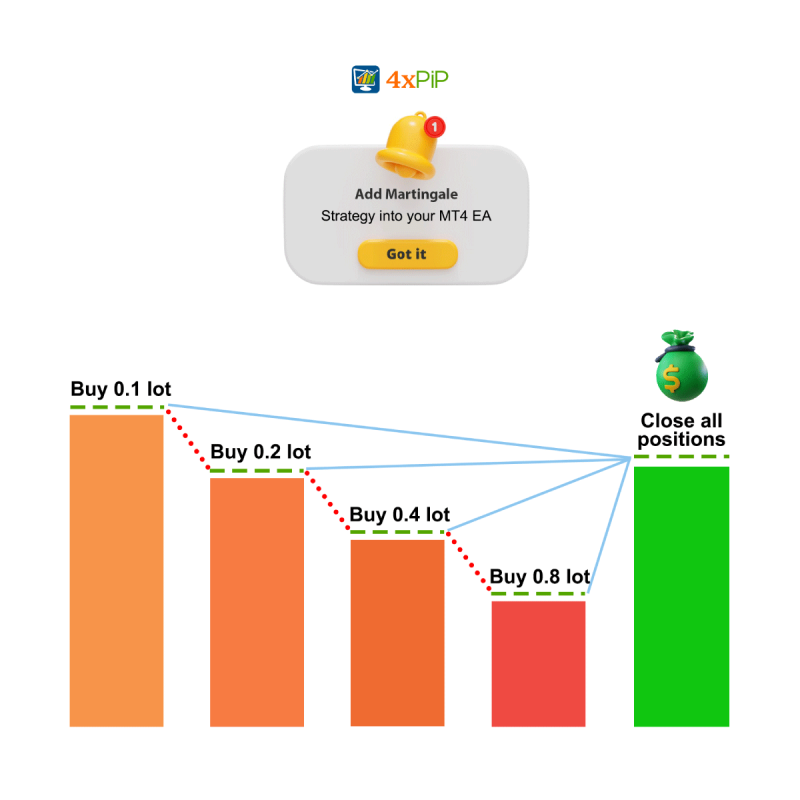
The core martingale principle in Forex trading is simple: when a trade goes into loss, the next position opens with an increased lot size to recover previous drawdown once price retraces. In practice, this means losses are not accepted individually but managed as a group. At 4xPip, we implement this logic through martingale orders, where each counter trade is opened at a defined distance (steps) in pips or points, and lot size increases using a configurable lot multiplier or lot increment. This is the foundation behind what many traders search for as the Best Martingale settings, but the mechanics always remain the same—loss recovery through controlled position scaling.
Inside an Expert Advisor, this process is fully automated. The bot executes buy and sell orders on MetaTrader (MT4/MT5), increases lot size before each new martingale order, and manages exits using a centralized take profit that dynamically adjusts based on the collective position of all open trades. At 4xPip, our programmers code this logic so trades are grouped and closed together in profit, even if individual positions close in loss. These EAs are typically deployed in ranging or low-volatility market conditions, where price oscillation allows grid spacing and recovery mechanisms to function as intended. This is why martingale strategies, while technically precise, depend heavily on market structure and correct configuration rather than blind automation.
Capital Exposure and Drawdown Risks
In a martingale strategy, capital exposure grows exponentially as position size increases after each losing trade. Every new Martingale order opens with a larger lot size based on the configured lot multiplier or lot increment, which means margin usage rises rapidly even if price moves only a limited distance against the initial position. At 4xPip, we design martingale bots with adjustable parameters such as Martingale distance, max martingale trades, and stopout percentage because without controlled inputs, even a short adverse move can stack multiple large positions and push exposure far beyond the original risk plan, regardless of how well the Best Martingale settings appear on paper.
Extended losing streaks amplify this risk. When price trends strongly in one direction, the EA continues opening counter trades until margin is exhausted or a stopout threshold is reached. This is where drawdown becomes imporant. Small accounts are disproportionately affected because limited balance restricts how many martingale orders can be sustained before margin calls occur. At 4xPip, we frequently see that traders running Martingale EAs on low-capital accounts experience faster drawdowns, even with conservative settings, while larger accounts can absorb deeper grids before recovery logic has a chance to function. This imbalance highlights why capital size and risk tolerance must align with martingale scaling mechanics.
Impact of Market Volatility and Trending Conditions
Strong trends and high-volatility phases are structurally challenging for martingale systems because price does not retrace within expected grid levels. When a market enters a directional move, each new Martingale Order opens at increasing lot sizes while price continues moving against the initial position. From our experience, this behavior directly stresses Lotsize Management, Lot Multiplier, and Martingale distance parameters. Even when using the Best Martingale settings for MetaTrader, grid-based recovery becomes less effective in trending conditions because centralized take profit keeps shifting while exposure grows faster than recovery potential.
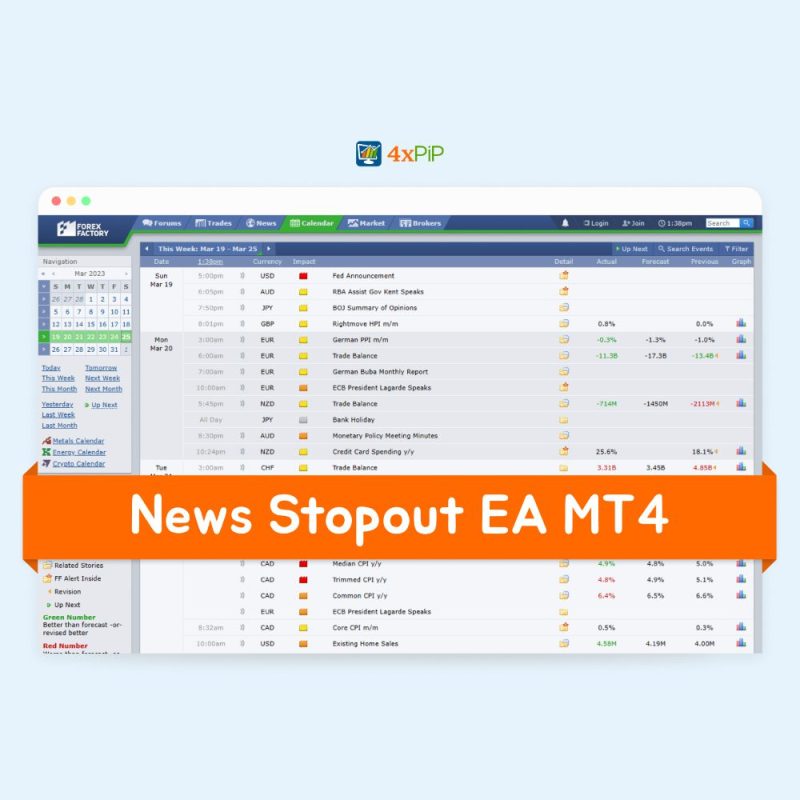
Sudden price movements accelerate loss accumulation by rapidly triggering multiple counter trades within seconds. News releases, high-impact economic events, and breakout-driven volatility often cause prices to skip predefined steps (grid spacing), forcing the EA to stack trades aggressively. At 4xPip, when programmers design or customize a Martingale EA for traders or EA owners, we account for these scenarios by allowing controls such as Max martingale trades, stopout percentage, and time filter. Common failure points include news spikes, range-to-trend transitions, and false breakouts where recovery logic cannot stabilize before margin pressure increases, making volatility management an important factor in martingale strategy deployment.
Leverage, Margin, and Broker Constraints
Leverage magnifies both profit potential and risk in martingale systems because every new Martingale Order increases position size through the lot multiplier or lot increment. At 4xPip, when we design or customize a Bot for a Trader or EA owner, we account for how leverage directly impacts Lotsize Management and margin usage inside MetaTrader (MT4/MT5). Higher leverage allows more grid levels to open, but it also accelerates drawdown when price moves against the Strategy. Even with the Best Martingale settings for MT4, leverage does not reduce risk, it only changes how quickly margin is consumed during adverse market movement.
Margin requirements and broker stop-out rules define the real operational limits of any martingale EA. As multiple counter trades open, used margin increases until a margin call or forced liquidation occurs, often before the centralized takeprofit can recover losses. From our work at 4xPip, broker-imposed constraints such as maximum lot size, minimum stop-out percentage, execution speed, and order limits directly affect how a martingale grid performs in live conditions. These constraints must be aligned with Max martingale trades, stopout percentage, and grid spacing, otherwise the EA may fail not due to logic flaws, but because broker rules prevent the recovery mechanism from completing its trade cycle.
Backtesting Limitations and Misleading Performance Results
Short-term backtests often present martingale strategies as consistently profitable because historical price action frequently provides enough retracements for the centralized takeprofit to close trade baskets in profit. We see this regularly when Traders or EA owners rely on brief MT4 strategy tester results without accounting for extended adverse moves. Backtests may not expose deep drawdowns caused by prolonged trends, especially when Martingale Orders, lot multiplier, and grid steps are optimized only for recent data. Even the Best Martingale settings for MT4 can appear flawless in limited samples while masking long-term capital risk.
Historical data quality and modeling assumptions further distort results. MT4 backtests cannot fully replicate real execution factors such as slippage, variable spreads, or broker stop-out behavior, and curve fitting parameters like Martingale distance or Max martingale trades often over-adapt to past conditions. From our development work at 4xPip’s Martingale EA, we emphasize forward testing on demo or small live accounts and stress testing across ranging, trending, and high-volatility markets. This approach validates whether the Strategy, recovery mechanism, and risk controls remain stable beyond idealized historical scenarios and under real trading constraints.
Risk Management Considerations for Traders Using Martingale EAs
Effective risk control is non-negotiable when running a martingale-based Strategy. At 4xPip, we structure Bots with practical safeguards such as Max martingale trades, controlled lot multiplier or lot increment, defined Martingale distance, and a configurable stopout percentage to cap downside exposure. These inputs work alongside Lotsize Management and centralized takeprofit logic to prevent uncontrolled trade stacking inside MetaTrader (MT4/MT5). Even when applying the Best Martingale settings for MT4, risk must be constrained at the system level, not left to market behavior or assumptions of recovery.
Account sizing plays a decisive role in whether a martingale EA remains operational during stress periods. In our opinion, Martingale Bots are unsuitable for underfunded accounts or capital that cannot tolerate deep drawdowns, even temporarily. We advise Traders and EA owners to isolate capital specifically allocated for high-risk strategies and avoid deploying martingale logic where emotional or financial tolerance is low. Martingale EAs are also inappropriate in conditions where prolonged trends dominate or where strict broker limits restrict recovery cycles. Understanding personal risk tolerance is very important, because no recovery mechanism can compensate for misaligned expectations or insufficient capital discipline.
Summary
Martingale Expert Advisors (EAs) are automated trading systems that increase position size after a loss to recover drawdowns, commonly deployed in Forex through MetaTrader 4 and 5. While their short-term profit potential and recovery-based logic attract traders, these systems carry inherent risks due to capital exposure, drawdowns, and sensitivity to market volatility. Factors such as leverage, broker constraints, and trending conditions can quickly overwhelm the EA, even when configured with optimal settings. Backtesting often exaggerates profitability, masking real-world risks. At 4xPip, we design and customize martingale EAs with safeguards, including lot management, centralized take profit, and configurable stopout limits, emphasizing practical risk controls, forward testing, and account-specific capital allocation to ensure more informed and disciplined trading decisions.
4xPip Email Address: [email protected]
4xPip Telegram: https://t.me/pip_4x
4xPip Whatsapp: https://api.whatsapp.com/send/?phone=18382131588
FAQs
- What is a Martingale Expert Advisor in Forex trading?
A Martingale EA is an automated trading bot that increases the lot size of new trades after a loss to recover previous drawdowns. It operates on platforms like MT4/MT5 and manages trades using lot multipliers, grid steps, and centralized take profit logic. - Why do traders use Martingale strategies?
Traders use Martingale strategies to potentially recover losses faster and achieve short-term profits. The strategy relies on trade scaling, grid spacing, and risk parameters to attempt recovery during ranging or low-volatility market conditions. - What are the main risks of using a Martingale EA?
The primary risks include exponential capital exposure, large drawdowns during trending markets, rapid margin consumption, and vulnerability to sudden volatility. Even well-configured EAs can fail if market conditions diverge from expectations. - How does market volatility affect Martingale EAs?
High volatility or strong trends can cause the EA to open multiple counter trades quickly, exceeding the recovery potential. Unexpected price spikes, news releases, and breakout events are common stress points where losses can escalate rapidly. - How do leverage and broker rules impact Martingale strategies?
Leverage increases both potential profits and risks. Broker rules, such as stopout thresholds, maximum lot sizes, and execution limitations, can prevent the EA from completing its recovery cycle, making careful alignment with strategy parameters essential. - Are backtest results reliable for Martingale strategies?
Backtests often show consistent profits because historical price retracements allow recovery logic to work. However, they may not reflect prolonged adverse trends, slippage, spread variations, or real-world execution, leading to misleading performance results. - How can traders manage risks when using a Martingale EA?
Risk management involves setting maximum martingale trades, controlled lot multipliers, defined grid spacing, stopout limits, and isolating capital. Combining these controls with disciplined account sizing reduces exposure to catastrophic drawdowns. - Can Martingale EAs work for small accounts?
Small accounts are highly vulnerable because limited balance restricts the number of trades that can be sustained during losing streaks. Martingale EAs are generally more suitable for accounts with sufficient capital to absorb deeper grids without triggering stopouts. - What role does account sizing play in Martingale trading?
Account size determines how long an EA can operate under stress. Adequate capital allows the recovery logic to function through temporary drawdowns, while underfunded accounts face higher risks of margin calls and forced liquidation. - How does 4xPip help traders with Martingale EAs?
At 4xPip, we design, customize, and test Martingale EAs with practical safeguards and forward-testing across different market conditions. Our approach ensures that risk controls, lot management, and recovery mechanisms are aligned with real trading constraints, helping traders make informed decisions rather than relying solely on theoretical setups.