In the world of foreign exchange (Forex) trading, traders are constantly seeking strategies that can help them maximize their profits. One such strategy that has gained popularity is the Martingale Strategy. But what exactly is the Martingale Strategy, and why do traders use it? This article by 4xPip serves as a guiding light for traders, providing invaluable insights and tools to navigate the challenges and potential rewards associated with strategies such as Martingale; we will demystify the Martingale Strategy, explain how it works, and explore why traders use it in forex trading. Whether you’re an experienced trader or a newbie in the forex market, understanding the Martingale Strategy can help you make informed decisions and manage your risk effectively. So, let’s get started and delve into the fascinating world of the Martingale Strategy in forex trading.
What Is The Martingale Strategy In Forex Trading?
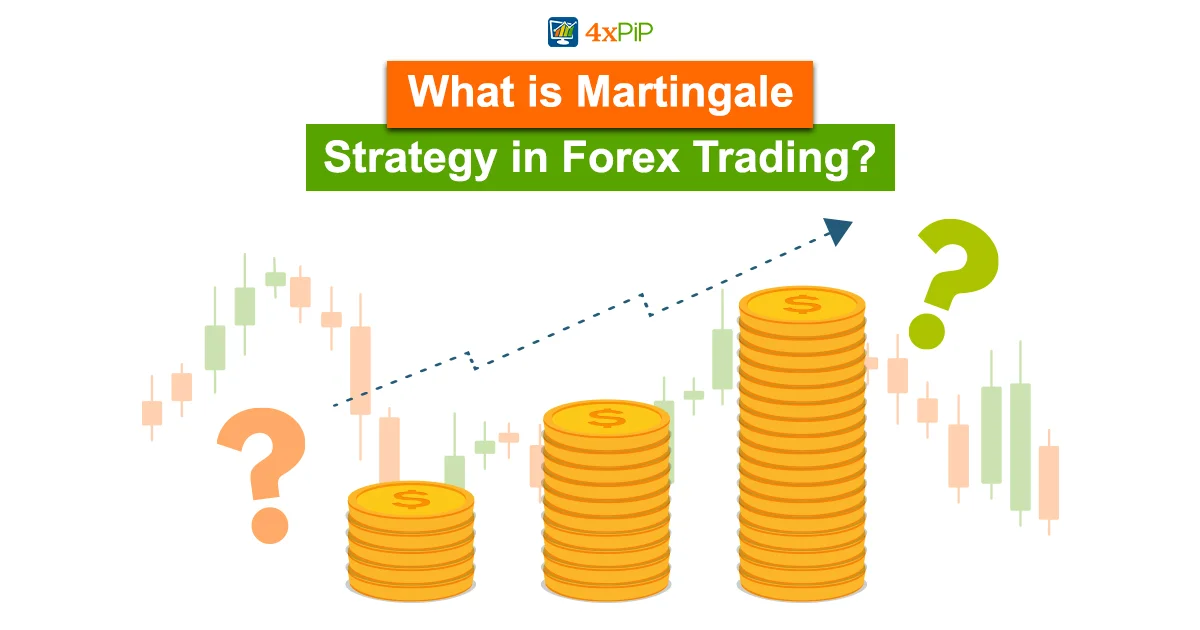
The Martingale Strategy, also known as the martingale system, is a popular system that originated in 18th-century France. The strategy suggests doubling your trades after each loss to recoup all previous losses and eventually make a profit. This concept has been adapted in the forex market, where traders apply it to their trading positions. The main idea behind the Martingale Strategy is the belief that a losing streak is bound to end and that increasing the size of your trades after each loss will eventually lead to a profitable trade.
Martingale trading stands as a widely embraced strategy in the forex markets. Several factors contribute to Martingale’s safety in the currency market.
Martingale strategies are based on the concept of mean reversion. Without significant savings to achieve favorable outcomes, one must withstand potential losses that could lead to the bankruptcy of an entire trading account. Additionally, it’s crucial to recognize that the risk amount on each trade exceeds the potential profit. Despite these challenges, there are methods to enhance the Martingale Strategy and increase the chances of success. 4xPip provides specialized Martingale products crafted to elevate trading strategies. These technological tools offer automated solutions, assisting traders with inefficient position size management and analyzing the Martingale strategy’s complexities.
How Does The Martingale System Work?
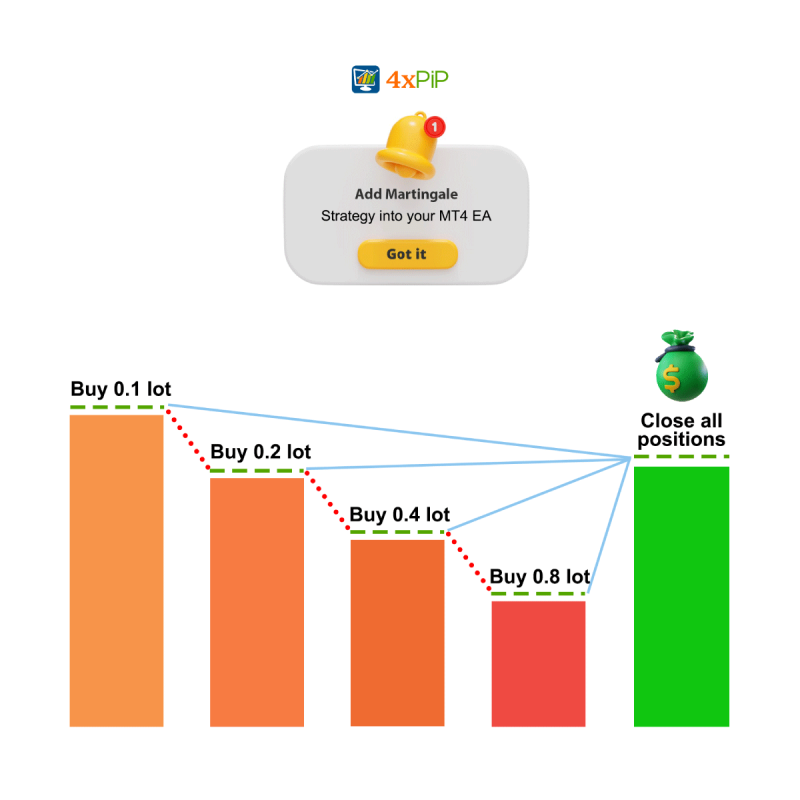
The Martingale Strategy demands doubling the trade size following each encountered loss. A typical application of this strategy involves attempting to trade an outcome with a 50% probability of occurrence. However, the core concept of the Martingale System is based on the statistical principle that continual losses are unlikely to occur. Therefore, it is advisable to raise the allocated investment amount, even if it is diminishing in value, in anticipation of a future upturn. The Martingale Strategy is applied in forex trading by enlarging the position size following each losing trade.
For instance, if a trader initiates a $10 trade and experiences a loss, they would subsequently double their trade size to $20 in the subsequent trade. If this trade also results in a loss, they would double it once more to $40, and the pattern continues. Traders believe that elevating the trade size effectively reduces their average entry price, enhancing the probability of a profitable trade.
Example of the Martingale Strategy
To get a better idea of how the Martingale Strategy functions in real life, let’s look at the following hypothetical situation:
A trader loses money repeatedly after making a $200 trade at first. After every loss, they double their trade size according to the Martingale Strategy. Following four defeats in a row, their trade amounts would be $200, $400, $800, and $1600.
The trader would make more money if the fifth trade were successful than if the losing trend continued. However, the approach may result in big losses if the trader experiences a significant drawdown or the losing run persists.
Anti-Martingale Strategy or Reverse Martingale Strategy
The Anti-Martingale system, or reverse Martingale, presents a contrasting approach to trading compared to the traditional Martingale system. While the Martingale strategy involves doubling down on losses, the anti-Martingale system capitalizes on winning streaks by doubling positions. Traders consider the anti-Martingale system a superior method, as it is less hazardous to raise trade size during a winning streak than during a losing streak. Yet, in a market uptrend, the anti-Martingale system holds the potential for success, allowing a trader to secure a sequence of profitable trades before a setback disrupts the streak. While markets driven by momentum might witness its effectiveness, the system could encounter challenges as markets can reverse direction against traders.
Limitations of Martingale Strategy
High-risk strategy: The Martingale Strategy is inherently risky, as it involves increasing trade sizes after each loss. If a trader experiences a prolonged losing streak can result in significant drawdowns and potential account blowouts.
Requires large trading account: Due to potential for exponential trade size increases, traders using Martingale Strategy need to have sufficient trading account size to withstand drawdowns. Traders may encounter margin calls or have to prematurely close positions if they lack sufficient capital.
Conclusion
The Martingale Strategy is a popular system that traders have adapted for use in forex trading. While it has the potential to generate significant profits, it also comes with substantial risks. In the world of forex, traders must educate themselves, stay updated with market trends, and adapt strategies to market conditions. By understanding concept and exploring strategies to Martingale Strategy, traders can make informed decisions and analyze forex market more effectively. Explore our Martingale Products to learn more about how 4xPip’s Martingale products can enhance your trading strategy. For personalized assistance and insights on integrating Martingale strategies into trading portfolio, contact 4xPip’s customer support at [email protected].
FAQ’s
What is the definition of a martingale?
Martingale strategy suggests doubling your trades after each loss to eventually recoup all previous losses and make a profit.
What is the martingale strategy?
The strategy suggests doubling your trades after each loss to recoup all previous losses and eventually make a profit. Traders apply this concept to their trading positions in the forex market.
What is a martingale example?
A trader loses money repeatedly after making a $200 trade at first. After every loss, they double their trade size according to the Martingale Strategy. Following four defeats in a row, their trade amounts would be $200, $400, $800, and $1600.
Is the martingale strategy legal?
The Martingale system is perfectly legal. The Martingale system finds notable application in various probability models.
What does Martingale Strategy propose?
The Martingale Strategy proposes that in the event of a trading loss, the trader should promptly increase the size of the subsequent trades. By consistently doubling the trades following losses, the trader aims to eventually achieve a winning trade and balance out their overall outcomes.
Why do they call it the Martingale strategy?
Martindale, an 18th-century London proprietor (his name is Martindale, with a “D”), would sometimes prod his patrons to double their investments after they lost.
Is the Martingale system safe?
The risk-to-reward ratio of the Martingale Strategy is not reasonable. At some point, there’s a potential that stocks will cease trading. When employing this technique, you initially limit the eventual reward to the amount invested, and you spend more significant sums with each loss until a win.
How does Martingale Strategy work?
The Martingale system is one of the earliest and most widely recognized strategies for success. In its fundamental form, the approach entails doubling the investment after losing trades. Consequently, winning allows the recovery of previous losses and yields profits for future trades.
Does Martingale Strategy work?
The Martingale System lacks a guarantee of success for several reasons. Notably, many exchanges impose restrictions on trade size, meaning there is limit to how much you can increase your investment.
How risky is Martingale?
The risk-to-reward ratio associated with Martingale Strategy is not rational. This strategy involves escalating investment amount after each loss until victory occurs, and ultimate profit only equals initial trade size.
What is the safest Martingale Strategy?
Cease the repetition after the fifth trade attempt. If the strategy proves ineffective, recommendation is to transition to different currency pair or commodity.