One of the biggest problems traders face is determining which price levels genuinely influence the market and which levels are simply random fluctuations. Many traders rely heavily on manually drawn support and resistance lines, delayed indicators, or subjective market structure interpretations that often create inconsistent trading decisions. In fast-moving markets, these traditional methods can cause traders to enter positions too late, misread momentum shifts, or place trades directly into weak zones where the market has little interest.
This issue becomes even more difficult when trading highly volatile instruments such as Forex pairs, indices, commodities, crypto assets, and metals. Price frequently revisits specific regions where institutional activity previously occurred, yet most standard indicators fail to highlight these areas effectively. Traders are then forced to react emotionally rather than planning entries in advance, which often leads to poor execution and unnecessary losses.
A smarter approach is to study how the market leaves traces behind during aggressive moves, liquidity grabs, and structural transitions. These areas frequently become important reaction points because they represent locations where substantial buying or selling activity previously entered the market. Instead of chasing candles after momentum has already unfolded, traders can focus on zones where price is statistically more likely to return.
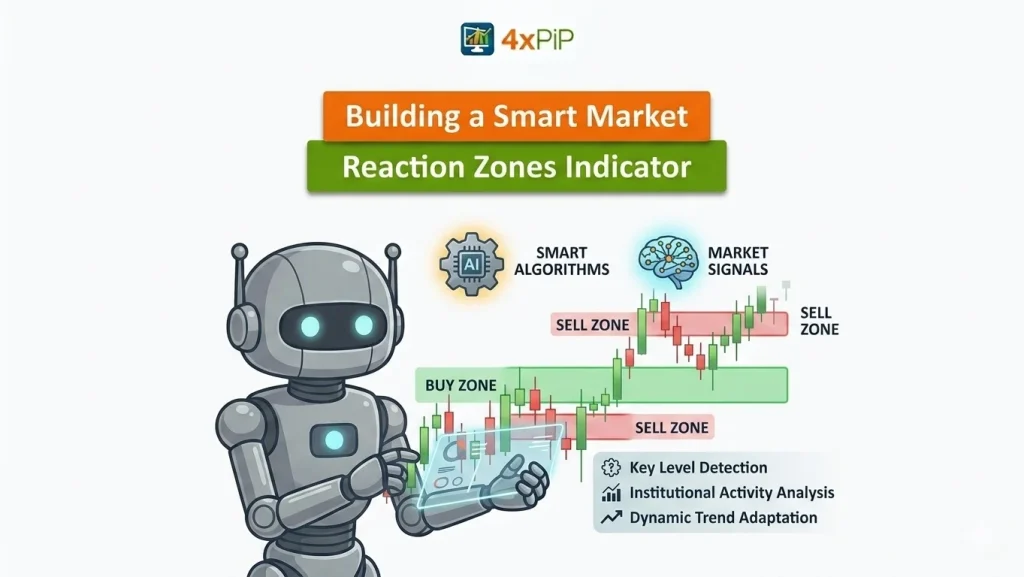
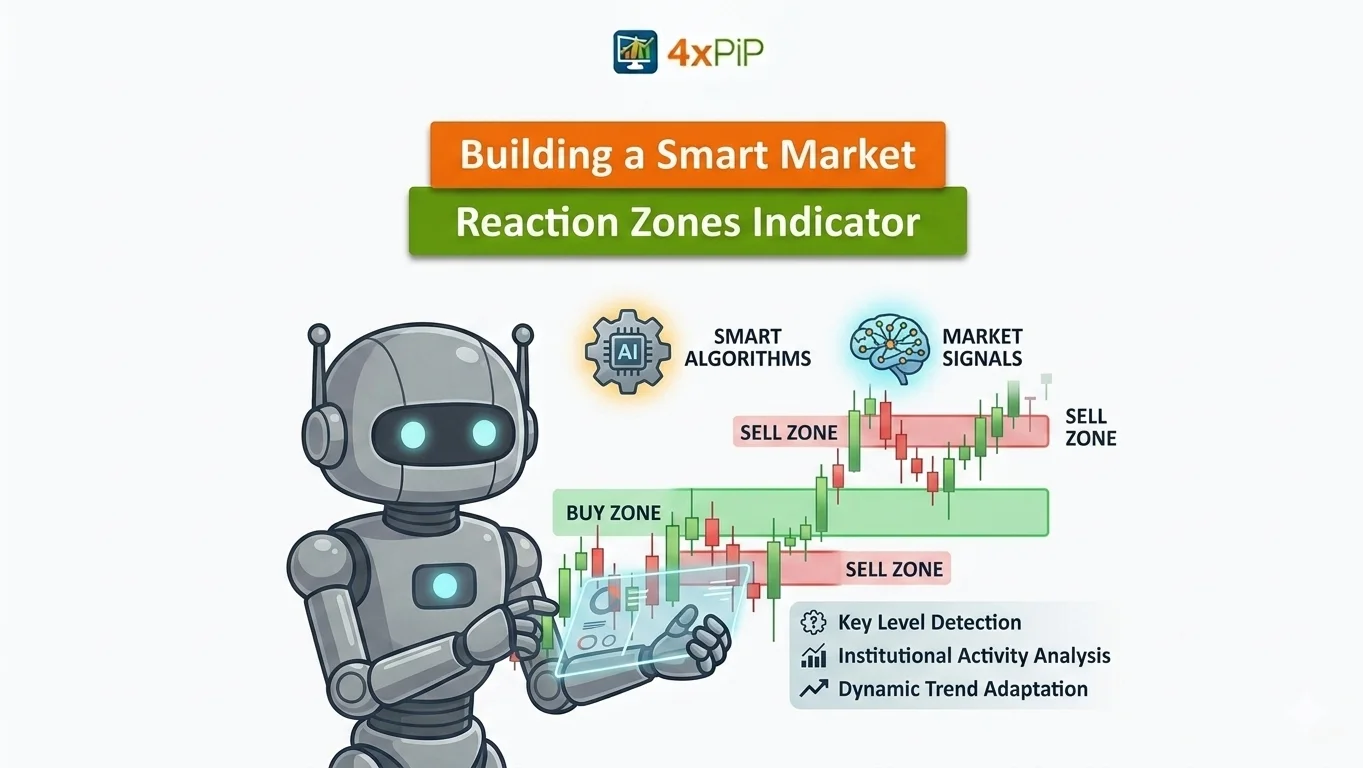
The Smart Market Reaction Zones concept was designed specifically to solve this problem. Rather than depending on arbitrary horizontal lines, the indicator automatically detects areas formed by impulsive movement, imbalance creation, liquidity sweeps, and market structure shifts. These zones provide traders with a cleaner framework for anticipating retracements, reversals, continuation setups, and potential re-entry opportunities.
At 4xPip, our MQL developers and trading system programmers focus heavily on building tools that simplify complex market behavior into practical decision-making frameworks. Our goal is not simply to create visually appealing indicators but to deliver intelligent automation solutions that save traders countless hours of chart analysis and manual testing. Before releasing any product, we perform extensive optimization and backtesting across MT4, MT5, Forex brokers, stock brokers, indices, commodities, metals, and cryptocurrency markets to ensure consistent performance under varying conditions.
Exploring the Smart Reaction Zones Indicator
The first category used inside this indicator is Momentum Expansion Zones. These zones are formed whenever the market produces an aggressive candle that moves substantially larger than surrounding candles. Such candles often indicate urgency from institutional participants or strong directional conviction. The indicator measures candle size relative to ATR values and validates whether the move contains minimal overlap with neighboring candles. This helps separate genuine displacement from ordinary volatility.
Momentum expansion areas are important because price frequently revisits them after a rapid move. During explosive movement, not every transaction is fully balanced, leaving behind inefficient price activity that the market may later revisit. Traders can use these zones to anticipate pullbacks, continuation setups, and possible reaction points where liquidity may still remain.
The second category focuses on Structural Shift Regions. These areas appear when the market changes directional behavior through a break in previous swing structure. For example, a bearish trend may suddenly create a higher low and break a previous swing high, signaling that control may be shifting from sellers to buyers. These transition points often become valuable future reference areas because they represent the location where market sentiment started changing.
Another major component involves Liquidity Reversal Origins. Financial markets constantly seek liquidity around obvious highs and lows where stop losses tend to accumulate. When price aggressively sweeps these areas and quickly reverses direction, the origin of that reversal often becomes highly significant. The indicator identifies these events and marks the region where the liquidity sweep originated, allowing traders to monitor future reactions around those levels.
In addition to identifying these advanced market behaviors, our team at 4xPip ensures that every indicator remains practical for real trading environments. We heavily optimize all logic for speed, low resource usage, and broker compatibility across multiple asset classes. This allows traders to focus more on execution and strategy development rather than spending weeks trying to manually identify these market behaviors themselves.
Initial Indicator Configuration
//+------------------------------------------------------------------+
//|                                      SmartReactionZones.mq5      |
//|                     Developed by 4xPip MQL Development Team      |
//+------------------------------------------------------------------+
#property copyright "4xPip"
#property version   "1.00"
#property indicator_chart_window
#property indicator_buffers 0
#property indicator_plots   0
// Input Parameters
input ENUM_TIMEFRAMES DetectionTF = PERIOD_CURRENT;
input int             HistoryDepth = 250;
input double          MinImpulseATR = 1.5;
input bool            EnableMomentumZones = true;
input bool            EnableImbalanceZones = true;
input bool            EnableStructureShifts = true;
input bool            EnableLiquiditySweeps = true;
input bool            EnableVolumeFilter = false;
input int             MaximumZones = 20;
input bool            ProjectZonesForward = true;
input int             ZoneTransparency = 25;
The opening section of the indicator establishes the primary configuration settings required for the Smart Reaction Zones system. Since this indicator depends entirely on graphical objects rather than traditional plotted buffers, the setup is configured directly inside the chart window. This approach allows the indicator to dynamically create visual price zones without relying on conventional line plotting methods.
Several user-defined inputs are included to give traders flexibility over how the indicator behaves. The timeframe selection controls where the analysis is performed, while the history depth determines how many candles are scanned during zone detection. ATR-based filtering is used to identify meaningful impulsive candles, helping eliminate weak movements that may not carry significant market intent.
Optional toggles allow traders to customize which types of zones appear on the chart. Momentum zones, imbalance areas, structural transitions, and liquidity sweeps can all be enabled or disabled individually. Additional controls such as transparency levels, zone extension behavior, and maximum active zones help maintain chart clarity even when analyzing highly active markets.
At 4xPip, our developers place strong emphasis on flexibility because traders use different strategies across different instruments. A scalper trading gold on MT5 requires a different visual environment compared to a swing trader analyzing NASDAQ indices or cryptocurrency pairs. This is why our systems are designed to adapt to multiple trading styles while maintaining consistent performance.
Building Zone Models and Data Structures
// Zone Categories
enum REACTION_ZONE_TYPE
{
   ZONE_MOMENTUM,
   ZONE_IMBALANCE,
   ZONE_STRUCTURE_SHIFT,
   ZONE_LIQUIDITY_ORIGIN
};
// Zone Data Container
struct ReactionZone
{
   datetime          startTime;
   datetime          endTime;
   double            upperPrice;
   double            lowerPrice;
   REACTION_ZONE_TYPE type;
   color             zoneColor;
   bool              active;
   int               sourceBar;
   double            probability;
   void Clear()
   {
     startTime = 0;
      endTime = 0;
      upperPrice = 0;
      lowerPrice = 0;
      active = false;
      sourceBar = 0;
      probability = 0.5;
   }
 bool ContainsPrice(double price)
   {
      return (price >= lowerPrice && price <= upperPrice);
   }
   bool IsConsumed(double high, double low)
   {
      return (low <= lowerPrice && high >= upperPrice);
   }
};
// Global Variables
ReactionZone reactionZones[];
int totalZones = 0;
double atrValues[];
double currentATR = 0.0;
string indicatorTag;
// Zone Colors
color momentumClr   = C'0,120,255';
color imbalanceClr  = C'255,140,0';
color structureClr  = C'150,0,255';
color liquidityClr  = C'255,60,60';
This part of the indicator establishes the internal framework used to classify and store all reaction zones detected by the system. The REACTION_ZONE_TYPE enumeration creates a structured labeling system that allows each zone to be categorized according to its market behavior. This improves code organization while ensuring each zone receives the correct processing logic and visual representation.
The ReactionZone structure acts as the primary data container for every identified market area. It stores essential information including the beginning and ending timestamps, upper and lower price boundaries, zone category, activation status, source candle, and a probability score used to estimate zone quality. Keeping all information centralized inside a structured model makes future updates and calculations significantly easier.
Several helper methods are also embedded directly inside the structure. The Clear function resets zone values whenever old data needs to be recycled. The ContainsPrice function quickly checks whether the current market price is trading inside a zone, while the IsConsumed function determines whether price has already fully traded through the region, allowing the indicator to deactivate invalid zones.
Global arrays and supporting variables manage the overall indicator environment. ATR calculations are stored separately for volatility measurements, while unique object names prevent chart conflicts when drawing graphical components. Different colors are assigned to each zone category so traders can instantly recognize whether an area represents momentum, imbalance, structural transition, or liquidity activity.
Our programmers at 4xPip use this structured development approach extensively when creating custom MT4 and MT5 indicators because scalability matters. Many traders eventually request additional features such as alerts, dashboards, scanner integration, or multi-timeframe analysis. Building clean internal data structures from the beginning makes future upgrades much easier and more stable.
Indicator Execution and Real-Time Processing
int OnInit()
{
   indicatorTag = "SRZ_" + IntegerToString(GetTickCount());
   IndicatorSetString(INDICATOR_SHORTNAME, "Smart Reaction Zones");
   IndicatorSetInteger(INDICATOR_DIGITS, _Digits);
   ArrayResize(atrValues, HistoryDepth);
   ArrayInitialize(atrValues, 0.0);
   ArrayResize(reactionZones, MaximumZones * 2);
   for(int i = 0; i < ArraySize(reactionZones); i++)
      reactionZones[i].Clear();
   currentATR = iATR(_Symbol, DetectionTF, 14);
   return INIT_SUCCEEDED;
}
void OnDeinit(const int reason)
{
   ObjectsDeleteAll(0, "SRZ_");
   ChartRedraw();
}
int OnCalculate(const int rates_total,
                const int prev_calculated,
                const datetime &time[],
                const double &open[],
                const double &high[],
                const double &low[],
                const double &close[],
                const long &tick_volume[],
                const long &volume[],
                const int &spread[])
{
   if(rates_total < HistoryDepth)
      return 0;
   ArraySetAsSeries(time, true);
   ArraySetAsSeries(open, true);
   ArraySetAsSeries(high, true);
   ArraySetAsSeries(low, true);
   ArraySetAsSeries(close, true);
   ArraySetAsSeries(tick_volume, true);
   currentATR = iATR(_Symbol, DetectionTF, 14);
   ScanReactionZones(rates_total, time, open, high, low, close, tick_volume);
   RefreshZones(rates_total, time, high[0], low[0]);
   return rates_total;
}
The lifecycle management of the indicator is controlled through the initialization, execution, and cleanup functions shown above. During startup, the system creates a unique object prefix to avoid naming conflicts with other indicators or chart tools. The indicator properties are then configured, and memory arrays are prepared for ATR calculations and zone storage.
The initialization phase also allocates space for all reaction zone objects while resetting each structure to default values. This ensures stable memory management before live calculations begin. ATR values are calculated immediately because volatility measurements play a major role in validating momentum-based market movements.
The deinitialization routine handles chart cleanup whenever the indicator is removed or refreshed. All graphical objects linked to the indicator are deleted automatically, preventing leftover rectangles and labels from cluttering the workspace.
The OnCalculate function acts as the engine that powers the entire system in real time. Every incoming candle triggers updated calculations, allowing the indicator to continuously scan for new reaction zones while managing previously detected areas. Price arrays are configured in series mode to simplify access to the latest market data, improving processing speed and reducing computational complexity.
At 4xPip, we prioritize optimization heavily because many traders operate multiple charts simultaneously. Our MQL developers routinely test indicators under high-load environments across Forex terminals, commodity charts, metals, stock CFDs, and crypto markets to ensure stable execution without unnecessary CPU strain.
Detecting High-Probability Reaction Areas
void ScanReactionZones(int rates_total,
                       const datetime &time[],
                       const double &open[],
                       const double &high[],
                       const double &low[],
                       const double &close[],
                       const long &tick_volume[])
{
   totalZones = 0;
   double averageVolume = CalculateAverageVolume(tick_volume, rates_total, 20);
   int startBar = MathMin(HistoryDepth, rates_total - 10);
   for(int i = startBar; i >= 3; i--)
   {
      if(EnableMomentumZones && totalZones < MaximumZones)
      {
         if(IsMomentumExpansion(i, high, low, open, close, tick_volume, averageVolume))
            AddMomentumZone(i, time, high, low, open, close);
      }
      if(EnableImbalanceZones && totalZones < MaximumZones)
      {
         if(IsPriceImbalance(i, high, low))
            AddImbalanceZone(i, time, high, low);
      }
      if(EnableStructureShifts && totalZones < MaximumZones)
      {
         if(IsMarketShift(i, high, low))
            AddStructureShiftZone(i, time, high, low);
      }
      if(EnableLiquiditySweeps && totalZones < MaximumZones)
      {
         if(IsLiquidityTrap(i, high, low, close, open))
            AddLiquidityOriginZone(i, time, high, low);
      }
   }
}
The core scanning routine is responsible for analyzing historical market data and identifying all major reaction zones. Each calculation cycle begins by resetting previous detections to ensure the indicator always reflects the most recent market conditions. Average volume calculations are also performed during this stage to support optional participation filtering.
The scanning loop processes candles from older price action toward newer data so that market structure develops naturally during analysis. This chronological approach allows the system to evaluate context properly while avoiding logical conflicts between future and past candles.
Momentum expansion zones are evaluated first because they represent aggressive institutional movement. The detection logic measures candle range relative to ATR values, verifies directional body dominance, and checks for limited overlap with surrounding candles. These filters help isolate meaningful displacement events while ignoring weak volatility spikes.
Imbalance zones are then identified through inefficiency analysis. The system searches for fair value gaps and incomplete retracement behavior where rapid movement left portions of price insufficiently traded. Such regions often attract future revisits as the market seeks to rebalance order flow.
Structural transitions and liquidity sweeps provide an additional layer of market intelligence. Swing analysis is used to detect changes in directional behavior, while liquidity traps identify stop hunts followed by strong reversals. Combining all of these detection models allows traders to view multiple forms of institutional activity within a single framework.
This type of automation is extremely valuable for traders who manually analyze dozens of charts daily. Our team at 4xPip builds these systems specifically to reduce analysis time while improving execution accuracy. Instead of spending hours drawing zones manually, traders can focus directly on confirmation and trade management.
bool IsMomentumExpansion(int bar,
                         const double &high[],
                         const double &low[],
                         const double &open[],
                         const double &close[],
                         const long &tick_volume[],
                         double averageVolume)
{

   double candleRange = high[bar] - low[bar];
   double minimumRange = currentATR * MinImpulseATR;
   if(candleRange < minimumRange)
      return false;
   double bodySize = MathAbs(close[bar] - open[bar]);
   if(bodySize < candleRange * 0.6)
      return false;
   if(EnableVolumeFilter)
   {
      double volumeRatio = (double)tick_volume[bar] / averageVolume;
      if(volumeRatio < 1.5)
         return false;
   }
   return true;
}
The momentum validation function shown above filters candles to locate only the strongest directional movements in the market. ATR-based validation ensures the candle is significantly larger than normal volatility conditions, while body dominance confirms that the movement was directional rather than indecisive.
Optional volume confirmation provides another layer of quality control by verifying that participation levels increased during the move. High-volume displacement often reflects institutional activity or heavy market interest, which increases the probability that the zone may remain relevant in future sessions.
By filtering weaker candles and focusing only on meaningful momentum events, traders receive cleaner signals and fewer distractions. This becomes particularly important in fast-moving assets like gold, NASDAQ indices, and cryptocurrency markets where random volatility can easily create misleading price movement.
Creating and Managing Dynamic Price Zones
void AddMomentumZone(int bar,
                     const datetime &time[],
                     const double &high[],
                     const double &low[],
                     const double &open[],
                     const double &close[])
{
   if(totalZones >= MaximumZones)
      return;
   reactionZones[totalZones].startTime = time[bar];
   reactionZones[totalZones].endTime = ProjectZonesForward
                                       ? TimeCurrent() + PeriodSeconds(_Period) * 100
                                       : time[bar];
   reactionZones[totalZones].upperPrice = high[bar];
   reactionZones[totalZones].lowerPrice = low[bar];
   reactionZones[totalZones].type = ZONE_MOMENTUM;
   reactionZones[totalZones].zoneColor = momentumClr;
   reactionZones[totalZones].active = true;
   reactionZones[totalZones].sourceBar = bar;
   double candleRange = high[bar] - low[bar];
   reactionZones[totalZones].probability =
      MathMin(candleRange / (currentATR * 2), 1.0);
   totalZones++;
}
void AddLiquidityOriginZone(int bar,
                           const datetime &time[],
                            const double &high[],
                            const double &low[])
{
   if(totalZones >= MaximumZones)
      return;
   reactionZones[totalZones].startTime = time[bar];
   reactionZones[totalZones].endTime = ProjectZonesForward
                                       ? TimeCurrent() + PeriodSeconds(_Period) * 100
                                       : time[bar];
   reactionZones[totalZones].upperPrice = high[bar];
   reactionZones[totalZones].lowerPrice = low[bar];
   reactionZones[totalZones].type = ZONE_LIQUIDITY_ORIGIN;
   reactionZones[totalZones].zoneColor = liquidityClr;
   reactionZones[totalZones].active = true;
   reactionZones[totalZones].sourceBar = bar;
   reactionZones[totalZones].probability = 0.9;
   totalZones++;
}
Once the indicator identifies a valid market reaction area, the corresponding zone must be created and stored correctly. Each Add function initializes the zone with all required properties including time boundaries, price limits, zone category, activation state, and visual appearance.
Momentum zones capture the full range of strong displacement candles because those candles often represent aggressive institutional participation. Probability ratings are calculated dynamically using ATR comparisons so that stronger market moves receive higher confidence scores.
Liquidity-origin zones are treated differently because stop hunts and reversal traps tend to carry a higher probability of future market interaction. These zones are assigned elevated probability values to reflect their historical tendency to generate strong reactions during retests.
The indicator also supports forward projection, allowing zones to extend into future chart space where traders can monitor upcoming interactions. This is particularly useful for swing traders who want to identify future retracement opportunities without constantly redrawing levels manually.
Zone management is extremely important in professional indicator development. Without proper handling, charts can quickly become overcrowded and confusing. At 4xPip, we carefully design every visual component to remain informative without overwhelming traders, especially those operating multi-monitor trading setups.
void RefreshZones(int rates_total,
                  const datetime &time[],
                  double currentHigh,
                  double currentLow)
{
   ObjectsDeleteAll(0, "SRZ_");
   for(int i = 0; i < totalZones; i++)
   {
      if(!reactionZones[i].active)
         continue;
      if(reactionZones[i].IsConsumed(currentHigh, currentLow))
      {
         reactionZones[i].active = false;
         continue;
      }
      DrawReactionZone(reactionZones[i], i);
   }
   DrawZoneLegend();
}
The refresh routine continuously manages the lifecycle of active zones on the chart. Before drawing updated information, old graphical objects are removed to prevent duplicates and maintain clean rendering.
The system also checks whether existing zones have already been fully mitigated by current price action. If the market has completely traded through a zone, the indicator automatically deactivates it to reduce unnecessary clutter.
Only valid zones remain visible, ensuring traders focus on areas that still carry potential market significance. This dynamic updating process helps maintain a clean analytical environment even during highly active trading sessions.
Rendering Zones and Visual Components
void DrawReactionZone(ReactionZone &zone, int index)
{
   string objectName = StringFormat("SRZ_%d_%d", index, (int)zone.startTime);
   if(ObjectCreate(0,
                   objectName,
                   OBJ_RECTANGLE,
                   0,
                   zone.startTime,
                   zone.upperPrice,
                   zone.endTime,
                   zone.lowerPrice))
   {
      ObjectSetInteger(0, objectName, OBJPROP_BACK, true);
      ObjectSetInteger(0, objectName, OBJPROP_FILL, true);
      ObjectSetInteger(0, objectName, OBJPROP_WIDTH, 1);
      int alpha = (int)(zone.probability * ZoneTransparency);
      alpha = MathMax(alpha, 15);
      alpha = MathMin(alpha, 85);
      color finalColor = ColorToARGB(zone.zoneColor, alpha);
      ObjectSetInteger(0, objectName, OBJPROP_COLOR, finalColor);
      string tooltip = StringFormat("Zone Type: %d\nProbability: %.2f",
                                    zone.type,
                                    zone.probability);
      ObjectSetString(0, objectName, OBJPROP_TOOLTIP, tooltip);
   }
}
The visualization layer is responsible for transforming raw market calculations into clear chart-based analysis. Every active zone is rendered as a rectangle positioned between its time boundaries and price range. Unique naming conventions prevent object conflicts while ensuring stable chart management.
Transparency levels are adjusted dynamically based on each zone’s calculated probability score. Stronger zones appear more visible, while weaker zones remain subtle in the background. This visual hierarchy helps traders quickly identify which areas may deserve the most attention.
Tooltips provide additional context whenever the trader hovers over a zone. Important information such as zone type and confidence score becomes instantly available without requiring separate panels or complex interfaces.
Professional visual design plays a major role in trader usability. Many indicators fail not because their logic is poor, but because their visual presentation overwhelms users. Our design philosophy at 4xPip focuses heavily on clarity, readability, and practical execution support.
void DrawZoneLegend()
{
   CreateLegendLabel("Momentum", 20, 20, momentumClr);
   CreateLegendLabel("Imbalance", 20, 40, imbalanceClr);
   CreateLegendLabel("Structure", 20, 60, structureClr);
   CreateLegendLabel("Liquidity", 20, 80, liquidityClr);
}
void CreateLegendLabel(string text,
                       int x,
                       int y,
                       color clr)
{
   string labelName = "SRZ_LABEL_" + text;
   ObjectCreate(0, labelName, OBJ_LABEL, 0, 0, 0);
   ObjectSetString(0, labelName, OBJPROP_TEXT, text);
   ObjectSetInteger(0, labelName, OBJPROP_XDISTANCE, x);
   ObjectSetInteger(0, labelName, OBJPROP_YDISTANCE, y);
   ObjectSetInteger(0, labelName, OBJPROP_COLOR, clr);
   ObjectSetInteger(0, labelName, OBJPROP_FONTSIZE, 10);
}
The legend system improves readability by helping traders immediately recognize what each color represents on the chart. Instead of memorizing multiple zone categories manually, traders can quickly reference the legend while analyzing price behavior.
Each label is positioned carefully to avoid interfering with candlestick visibility. Minimalistic styling keeps the chart clean while still delivering useful context.
This type of interface design becomes especially valuable during high-speed market conditions where traders need rapid visual interpretation. Whether trading EURUSD during London session volatility or monitoring Bitcoin during weekend expansion, quick recognition of zone types can significantly improve reaction speed.
Smart Reaction Zones in Live Trading Conditions
Forex Market Example
Consider a trader analyzing EURUSD on the H1 timeframe. During the New York session, the market produces a strong bullish displacement candle following a major economic release. The Smart Reaction Zones indicator immediately detects the aggressive expansion and marks the candle range as a momentum zone.
A few hours later, price retraces back into the highlighted region before continuing upward again. Instead of chasing the breakout at poor prices, the trader uses the previously identified reaction zone as a planned entry location with tighter risk management.
Indices Trading Example
When trading indices such as NASDAQ or US30, liquidity sweeps frequently occur around previous session highs and lows. Suppose price briefly spikes above a previous high during market open volatility before reversing sharply downward.
The indicator identifies the liquidity grab and marks the reversal origin as a high-probability reaction area. If price later revisits that same zone, traders can monitor for bearish confirmation signals and potential continuation opportunities.
Commodity and Metals Example
Gold and crude oil markets are highly sensitive to impulsive institutional movement. During periods of geopolitical uncertainty, these instruments often produce large displacement candles followed by retracements into imbalance zones.
For example, XAUUSD may rally aggressively after central bank news, leaving behind inefficient pricing during the expansion. The indicator highlights this imbalance automatically, allowing traders to anticipate possible pullbacks into the zone before trend continuation resumes.
Cryptocurrency Trading Example
Crypto markets are extremely volatile and often create repeated liquidity traps around psychological price levels. Bitcoin may sweep below a major support level, trigger stop losses, and then reverse strongly upward.
The Smart Reaction Zones indicator identifies this liquidity-origin zone immediately. Traders watching the retest can then combine the zone with volume confirmation or candlestick patterns to improve timing precision.
At 4xPip, our testing team spends significant time validating indicators across real-world trading environments before release. We backtest systems on MT4 and MT5 using Forex brokers, stock brokers, metals, commodities, indices, and crypto assets to ensure the logic performs consistently across multiple market conditions. This process helps traders move directly toward execution rather than spending weeks performing manual optimization themselves.
Conclusion
Developing the Smart Market Reaction Zones indicator required combining multiple forms of market behavior into a single structured analytical framework. Momentum expansion zones, imbalance regions, structural transitions, and liquidity sweep origins were all integrated to help traders identify areas where price may revisit with increased probability.
Through structured zone models, dynamic calculations, probability scoring, and graphical rendering systems, the indicator transforms complex market behavior into practical visual analysis. Rather than forcing traders to manually identify these conditions themselves, the system continuously scans and updates the chart automatically in real time.
The ability to focus on meaningful market memory rather than random support and resistance can significantly improve decision-making quality. Traders gain clearer entry planning, better retracement analysis, improved risk management, and a more organized understanding of institutional price behavior.
At 4xPip, our mission is to develop advanced trading tools that reduce complexity while improving execution efficiency. Our MQL developers, programmers, and trading automation specialists continuously build and optimize indicators, Expert Advisors, trading bots, and custom systems designed to save traders time and improve workflow.
By combining strong market logic with practical visualization, the Smart Reaction Zones indicator provides traders with a professional framework for identifying high-interest areas where price is likely to react again in the future. Whether applied to Forex, crypto, commodities, metals, or indices, the underlying concept remains the same: markets