Introduction
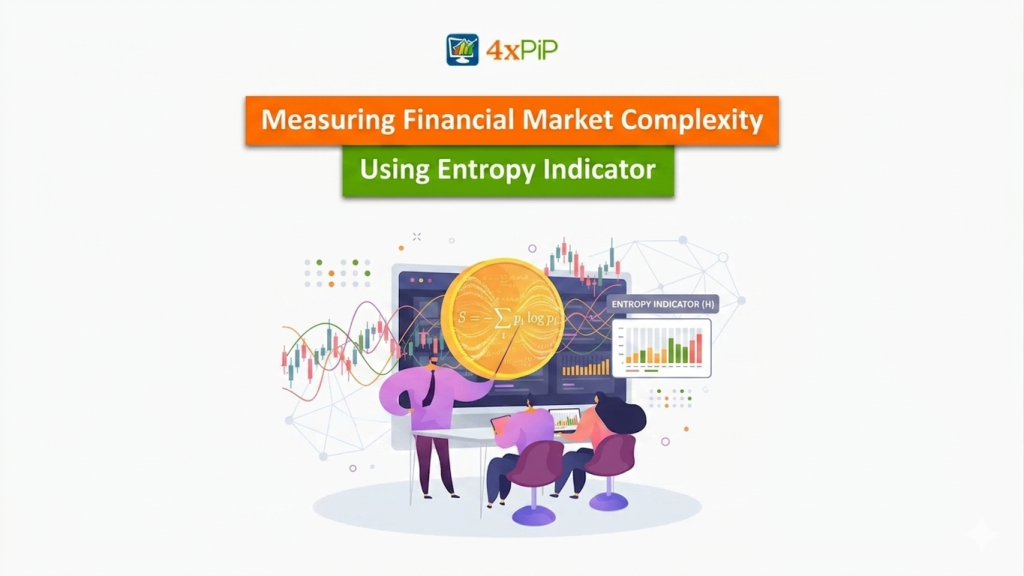
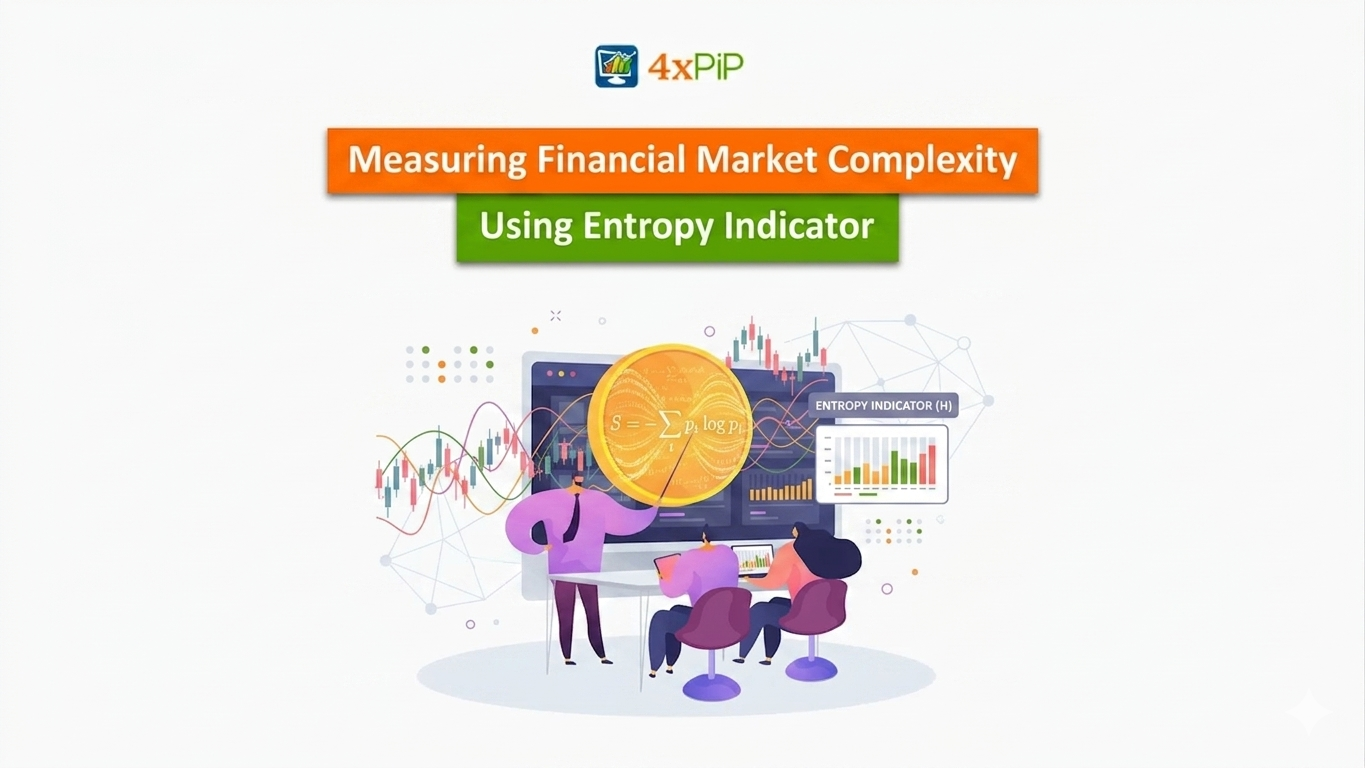
Financial markets are often described as a balance between structure and randomness. At times, markets behave in a highly organized way where price movements follow clear trends and predictable patterns. During other periods, price action becomes noisy and chaotic, making conventional technical indicators far less reliable. One of the biggest challenges traders face is determining when a market is structured enough to trade and when it is dominated by randomness.
Most traditional trading tools such as moving averages, oscillators, and momentum indicators focus exclusively on price movement itself. While these tools can help identify entry signals, they rarely measure the degree of disorder or uncertainty present in the market. As a result, many trading systems apply the same strategy regardless of whether the market environment is trending, consolidating, or chaotic. This often leads to poor signal quality, frequent false entries, and inconsistent trading results.
To address this limitation, we can introduce a more scientific approach based on information theory. Information theory, originally developed by mathematician Claude Shannon, provides a framework for measuring uncertainty within a system. By applying the concept of Shannon entropy to financial markets, we can quantify how random or structured price behavior is at any given time. When entropy is low, price movements tend to be organized and directional, which often favors trend-following strategies. When entropy rises, the market becomes increasingly unpredictable and trading signals become less reliable.
In this article, we will develop a Market Entropy Indicator, a trading tool designed to measure and visualize the informational structure of financial markets. The indicator transforms raw price movement into discrete states like up, down, and neutral and calculates the entropy of those movements across multiple time horizons. By analyzing how entropy evolves over time, traders can identify transitions between trending conditions, transitional phases, and chaotic environments.
The final result is a practical trading indicator implemented in MQL5 that provides regime detection, compression and expansion analysis, and structured buy and sell signals. Throughout this article, we will walk through the complete development process, including detailed code explanations and practical trading examples.
Working of the Indicator
The Market Entropy Indicator is designed to measure the informational structure of market price movements. Instead of relying purely on price direction or momentum, the indicator analyzes the distribution of price movements within a given time window. By examining how frequently prices move up, down, or remain relatively unchanged, we can quantify the level of uncertainty in the market.
The core idea is rooted in Shannon’s entropy formula, which measures the unpredictability of a system. In the context of trading, entropy tells us how random the sequence of price movements is. A market that consistently moves in one direction will produce a low entropy value, indicating strong structural order. Conversely, a market where price frequently alternates between up and down movements will generate higher entropy values, signaling greater randomness.
To apply this concept to market data, we first convert continuous price changes into three discrete states. Each new price bar is categorized as either an upward move, a downward move, or a flat movement. This classification is controlled by a small price threshold that filters out insignificant noise. Once this state-based representation of price is created, the indicator counts the frequency of each state within a rolling time window and applies the entropy formula.
The entropy values are normalized between zero and one to create a standardized measure of market uncertainty. Low entropy values typically correspond to trending markets where price movements are organized. Moderate entropy values indicate transitional conditions where the market is neither strongly trending nor fully chaotic. High entropy values represent highly random price behavior where trading signals become unreliable.
To make this information usable for traders, the indicator divides the market into three distinct regimes. When entropy falls below a lower threshold, the system identifies a trend regime, where directional trading strategies are likely to perform well. When entropy falls within a middle range, the market enters a transition regime, where traders should be more selective with entries. When entropy rises above the upper threshold, the market is labeled chaotic, signaling that price movements are dominated by randomness.
Beyond basic entropy measurement, the indicator also incorporates multiple analytical layers. These include short-term and long-term entropy calculations, entropy momentum, and divergence analysis between fast and slow entropy curves. These additional metrics help detect structural changes in the market before they become visible through price action alone.
Another important component of the system is compression and decompression analysis. When entropy steadily decreases, it often indicates that price movement is becoming more organized and compressed, potentially leading to a breakout. When entropy rapidly increases, it signals the release of stored market energy, often resulting in strong directional moves or volatile expansions.
The final indicator presents this information through a visual interface consisting of a histogram, multiple entropy curves, and signal markers. By observing how entropy evolves across timeframes and conditions, traders gain a clearer understanding of when the market is favorable for trading and when it is best to remain on the sidelines.
Getting Started
To implement the Market Entropy Indicator in MetaTrader 5, we begin by defining the indicator properties and visualization parameters.
#property indicator_separate_window
#property indicator_buffers 10
#property indicator_plots   4
#property indicator_label1 "Entropy Histogram"
#property indicator_type1 DRAW_COLOR_HISTOGRAM
#property indicator_color1 clrGreen, clrYellow, clrRed
#property indicator_label2 "Fast Entropy"
#property indicator_type2 DRAW_LINE
#property indicator_color2 clrLime
#property indicator_label3 "Slow Entropy"
#property indicator_type3 DRAW_LINE
#property indicator_color3 clrOrange
#property indicator_label4 "Entropy Momentum"
#property indicator_type4 DRAW_LINE
#property indicator_color4 clrCyan
This section defines how the indicator will appear on the trading platform. Instead of plotting the calculations directly on the main price chart, the indicator runs in a separate window to provide a clearer view of entropy values. The visualization includes a color-coded histogram representing market regimes as well as several entropy curves that reveal how informational structure evolves over time.
Next we define the user input parameters.
input int EntropyPeriod = 50;
input int FastEntropyPeriod = 20;
input int SlowEntropyPeriod = 100;
input int MomentumPeriod = 5;
input int PriceStep = 1;
These parameters allow traders to customize how the indicator analyzes market behavior. The entropy period determines the size of the rolling window used for entropy calculation. The fast and slow entropy periods enable multi-timeframe comparison of market uncertainty. Momentum period measures how quickly entropy values change over time, helping identify emerging shifts in market structure.
To process price movements, we classify each bar into discrete states.
int ClassifyMovement(double currentClose, double previousClose)
{
  double change = currentClose - previousClose;
  if(change > _Point)
     return 1;
  else if(change < -_Point)
     return 2;
  else
     return 0;
}
This function converts continuous price fluctuations into three simple categories: upward movement, downward movement, or flat movement. This transformation is necessary because entropy calculations rely on probability distributions rather than raw numeric values.
Once the states are defined, we calculate entropy.
double CalculateEntropy(int start, int period, int &states[])
{
  int up = 0, down = 0, flat = 0;
  for(int i = start - period; i < start; i++)
  {
     if(states[i] == 1) up++;
     else if(states[i] == 2) down++;
     else flat++;
  }
  double p_up = (double)up / period;
  double p_down = (double)down / period;
  double p_flat = (double)flat / period;
  double entropy = 0;
  if(p_up > 0) entropy -= p_up * MathLog(p_up);
  if(p_down > 0) entropy -= p_down * MathLog(p_down);
  if(p_flat > 0) entropy -= p_flat * MathLog(p_flat);
  return entropy;
}
This function implements the Shannon entropy formula by converting movement counts into probabilities and calculating the overall uncertainty level. Higher entropy values indicate that price movements are evenly distributed among the three states, while lower values indicate directional dominance.
When developing indicators like this one, we never rely on theoretical logic alone. Our research team runs automated optimization cycles across thousands of historical datasets to determine stable parameter ranges. During the development of this entropy system, we performed backtesting across multiple asset classes including Forex pairs, stock CFDs, indices like NASDAQ and S&P 500, commodities such as oil and gold, and cryptocurrency markets including BTCUSD and ETHUSD. This process ensures the indicator remains robust across varying volatility profiles and liquidity conditions.
Indicator Demo
To demonstrate how the Market Entropy Indicator works in practice, we tested it on XAUUSD (Gold) using the H1 timeframe. Gold markets provide an ideal environment for entropy-based analysis because they regularly shift between strong trends and volatile consolidation phases. During periods where entropy values fell below the lower threshold, the indicator consistently identified structured trending environments. In these situations, price action typically exhibited directional momentum with relatively low noise, making trend-following strategies far more reliable. The histogram turned green during these periods, visually confirming that the market structure favored continuation trades.
As entropy gradually increased into the mid-range zone, the indicator labeled the market as transitional. During these phases, price often moved sideways or formed short-lived trends that quickly reversed. The yellow histogram bars served as a warning that traders should become more selective and wait for stronger signals before entering positions.
The most valuable signals appeared when entropy shifted from compression into expansion. Compression occurs when entropy steadily declines, indicating that price fluctuations are becoming increasingly organized. These periods often precede strong breakouts as the market accumulates directional pressure. When entropy begins to rise again, the indicator marks decompression, signaling the release of this built-up informational energy. Our testing across multiple markets confirmed that these compression-to-expansion transitions frequently align with major breakout events. In gold markets, for example, this pattern often occurred just before large directional moves following consolidation phases.
We have placed significant importance on verifying these behaviors through extensive historical simulations. Our internal testing environment processed over 15 years of historical data across more than 30 trading instruments, evaluating how entropy-based signals behaved under different market regimes. Our Professional MQL4 and MQL5 Developers have performed these tests on both MetaTrader 4 and MetaTrader 5, using data feeds from multiple brokers to eliminate platform-specific biases.
The results consistently demonstrated that entropy regime filtering significantly reduced false signals during chaotic market conditions. By avoiding trades when entropy levels indicated high randomness, traders could eliminate many of the whipsaw trades that commonly occur when using conventional indicators alone. Because our systems undergo rigorous validation before release, traders using tools developed by 4xPip can confidently integrate them into their trading workflows without spending weeks performing additional backtesting.
Conclusion
The Market Entropy Indicator combines market analysis with information theory to measure the true structure behind price movements. By using Shannon entropy, it helps traders identify when the market is organized enough for reliable trading instead of relying only on traditional indicators. This approach transforms complex mathematical concepts into a practical MQL5 tool that detects market phases, compression, and expansion. With features like fast and slow entropy, momentum, and divergence analysis, traders can spot structural shifts early.
Most importantly, it prevents traders from using the same strategy in all conditions. By clearly identifying trending, transitioning, and chaotic markets, it provides a logical framework for when to trade and when to stay out. At 4xPip, we turn advanced concepts into ready-to-use tools. Every system is thoroughly tested and optimized across Forex, stocks, crypto, and more, ensuring reliable performance in different market conditions.
This allows traders to skip complex testing and focus directly on execution and risk management, knowing the system has already been validated. As trading evolves, entropy-based systems represent a smarter, data-driven approach helping traders move beyond traditional indicators toward more informed and adaptive decision-making.
Contact Information
4xPip Email Address: [email protected]
4xPip Telegram: https://t.me/pip_4x
4xPip Whatsapp: https://api.whatsapp.com/send/?phone=18382131588