AI trading robots, also known as algorithmic trading systems or Expert Advisors (EAs), have become extremely popular in Forex and financial markets. They promise speed, discipline, and fully automated execution without emotional interference. However, behind the excitement lies an important truth: AI trading robots are not magic profit machines, they are tools that come with real risks.
In this guide, we will explore the key risks of AI trading robots, how they behave in live markets, and what traders should carefully consider before relying on automation. Whether you are a beginner or an experienced trader, understanding these risks will help you make smarter and safer trading decisions with platforms like 4xPip ( Forex pips ).
AI Trading Robots Are Everywhere But What Are the Real Risks?
AI trading robots are software programs designed to analyze financial markets and execute trades automatically based on predefined rules or machine learning models. They are widely used on platforms like MetaTrader 4 (MT4) and MetaTrader 5 (MT5) to remove manual decision making from trading.
The main reason traders adopt these systems is simple: automation brings speed and discipline. Instead of reacting emotionally, the robot follows logic. However, that same automation can become a weakness when market conditions change unexpectedly.
Some common reasons traders use AI trading robots include:
- 24/7 market monitoring without human fatigue
- Faster trade execution compared to manual trading
- Ability to test strategies on historical data
- Emotion-free trading decisions
While these advantages are attractive, they should always be balanced with an understanding of potential risks.
How AI Trading Robots Actually Work in Real Markets
At their core, AI trading robots operate on programmed logic or trained models that analyze market data and generate trading signals. These systems use indicators, price patterns, or statistical models to decide when to enter or exit trades. Once conditions are met, the robot automatically places orders, sets stop loss and take profit levels, and manages trade execution without human involvement.
A simplified workflow usually looks like this:
- Market data is collected in real time
- The algorithm evaluates trading conditions
- Buy or sell signals are generated
- Trades are executed automatically on the platform
The issue is that this process assumes markets behave consistently but in reality, financial markets are highly dynamic and often unpredictable.
Key Risks of AI Trading Robots You Should Never Ignore
Despite their intelligence, AI trading robots come with several risks that can significantly impact trading performance. Understanding these risks is essential before using any automated system. One major risk is dependency on historical data. Many robots are trained or optimized using past market conditions, which may not reflect future behavior. This can lead to inaccurate predictions when volatility increases or market trends shift. Another concern is lack of adaptability. Most trading robots cannot react intelligently to unexpected events such as economic news, geopolitical tension, or sudden liquidity changes.
Common risks include:
- Over-reliance on past data
- Failure during high volatility periods
- Inability to interpret fundamental news
- Sudden drawdowns due to rigid logic
- Technical failures or execution delays
These risks highlight why AI trading systems should never be treated as “set and forget” solutions.
Overfitting and Optimization Problems in AI Trading
One of the biggest hidden dangers in AI trading systems is over-optimization, also known as curve fitting. This happens when a robot is too finely tuned to past data, making it look extremely profitable in backtests but weak in live markets.
When a system is over optimized, it essentially memorizes historical conditions instead of learning general market behavior. As a result, even small changes in market structure can lead to poor performance. This is one of the most common reasons traders experience losses after switching from demo to live trading. To reduce this risk, traders should always prioritize realistic testing rather than perfect backtest results.
When the Market Changes Faster Than Your AI Can Adapt
Financial markets are influenced by countless unpredictable factors such as news events, central bank decisions, and global economic shifts. AI trading robots struggle in these environments because they rely on structured logic rather than human intuition.
For example, during major news releases, price movements can become extremely erratic. A robot that normally performs well in stable conditions may execute poor trades or exit positions too early. This unpredictability is why even the most advanced systems cannot guarantee consistent profits.
Key challenges include:
- Sudden spikes in volatility
- Liquidity gaps during major events
- Rapid trend reversals
- Unexpected correlation shifts
Because of this, manual oversight or hybrid trading strategies are often recommended.
One Technical Glitch Can Turn Profits Into Losses
AI trading robots also depend heavily on technology, which introduces another layer of risk. Issues such as server downtime, internet connectivity problems, or platform crashes can disrupt trading performance. Even small delays in execution can lead to significant differences in trade outcomes, especially in fast moving markets like Forex.
Technical risks often include:
- Broker execution delays
- VPS or server downtime
- Software bugs or coding errors
- Incorrect parameter settings
- Platform compatibility issues
These risks emphasize the importance of proper setup, monitoring, and maintenance.
Bad Data, Bad Decisions, Why AI Isn’t Always Right
Another often overlooked issue is data bias. If a trading robot is trained using limited or biased datasets, its decision making process will also be flawed. This can result in strategies that work only in specific market conditions. For example, a robot trained during a strong trending market may fail completely in sideways or ranging conditions. To reduce this risk, strategies must be tested across multiple market cycles, including high volatility, low volatility, and trending phases.
How Smart Traders Protect Themselves From Automation Risks
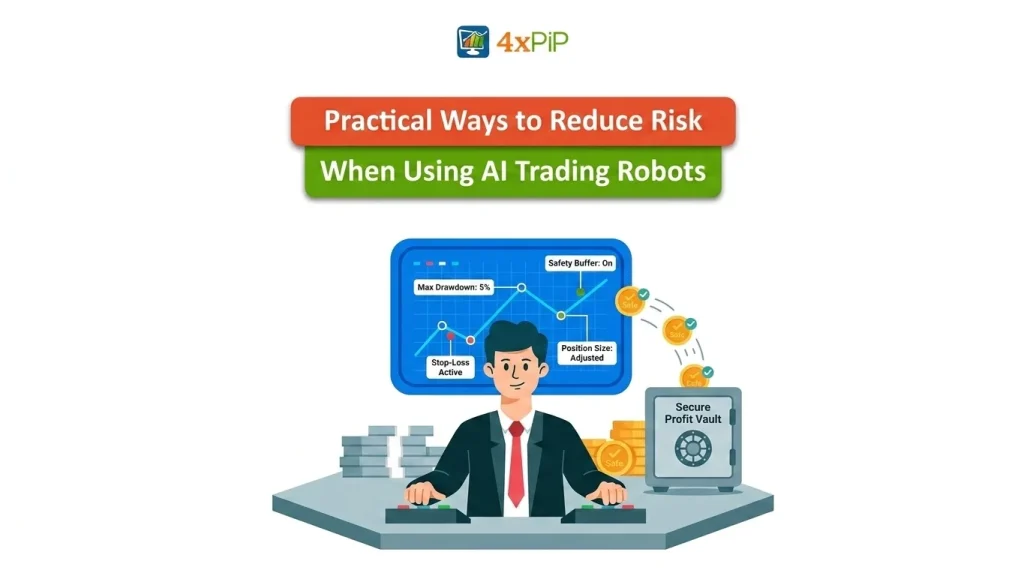
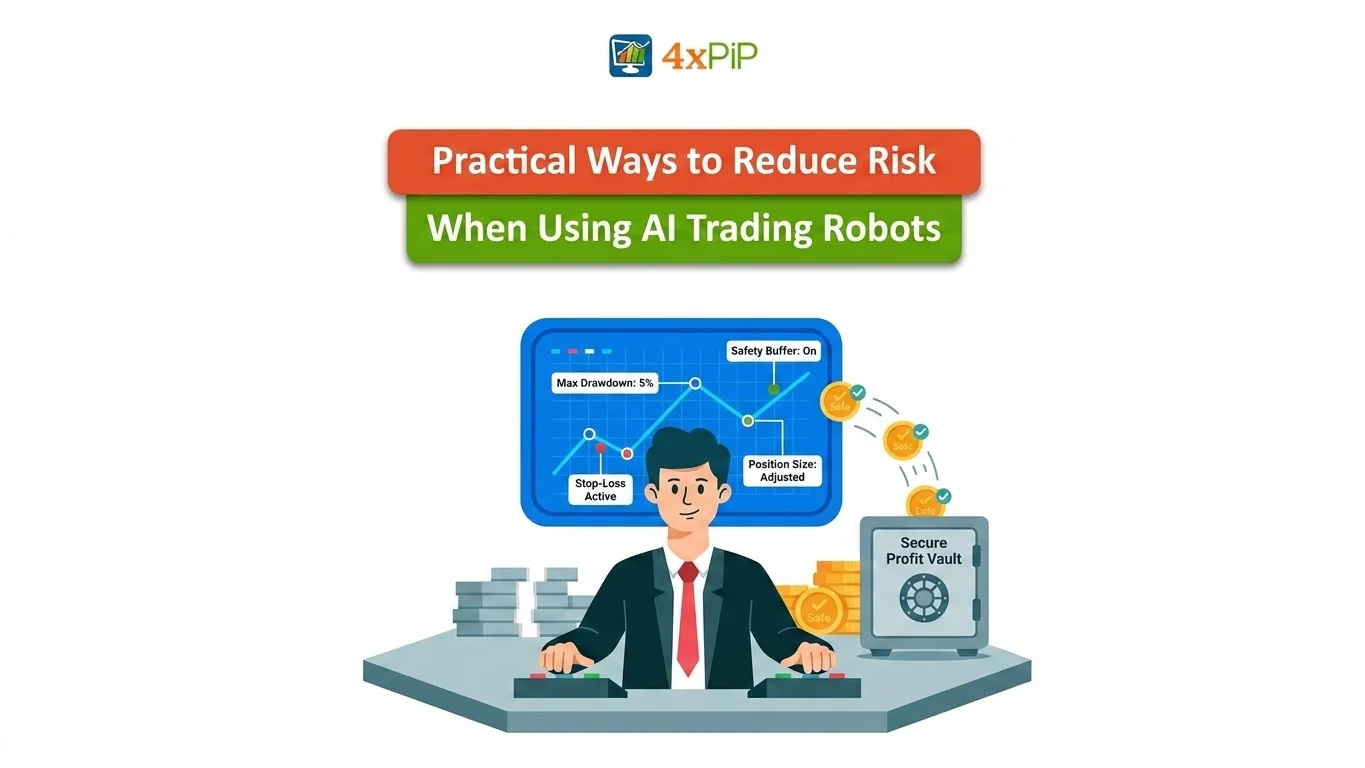
While risks cannot be completely eliminated, they can be significantly reduced with proper development, testing, and monitoring practices. A responsible approach to AI trading includes structured risk management and continuous optimization rather than full automation without supervision.
Best practices include:
- Regular backtesting across different market conditions
- Using proper stop loss and risk control settings
- Avoiding over-optimized strategies
- Monitoring live performance consistently
- Updating algorithms based on market changes
By following these principles, traders can improve reliability and reduce unexpected losses.
How 4xPip Helps Minimize AI Trading Risks
At 4xPip ( Forex pips ), AI trading systems and Expert Advisors are developed with a strong focus on stability, risk management, and real-market performance. Instead of relying on generic algorithms, each system is built according to the trader’s specific strategy and requirements.
The development process includes careful coding, structured testing, and optimization to ensure the system performs reliably in both backtesting and live environments. With this approach, traders get a more controlled and transparent automation experience instead of blindly relying on untested systems.
4xPip Email Address: [email protected]
4xPip Telegram: https://t.me/pip_4x
4xPip WhatsApp: https://api.whatsapp.com/send/?phone=18382131588
Summary
AI trading robots can be powerful tools, but they are not risk-free solutions. From over-optimization and technical failures to market unpredictability and data bias, these systems require careful handling and continuous supervision. The key to success is not just automation, but smart automation.
When properly designed and managed, AI trading systems can support traders effectively but they should always be used with realistic expectations. With expert development and structured risk control from providers like 4xPip, traders can reduce many of these risks and build more reliable automated trading systems.
FAQs
1. Are AI trading robots safe to use?
They are safe when properly developed and monitored, but they still carry market and technical risks.
2. Can AI trading robots guarantee profits?
No trading system can guarantee profits due to unpredictable market conditions.
3. What is the biggest risk in AI trading?
Over-optimization and poor performance in live markets are among the biggest risks.
4. Do AI trading robots work during news events?
Most robots struggle during high-impact news due to extreme volatility.
5. What causes AI trading robots to fail?
Common causes include poor strategy design, technical errors, and market changes.
6. Can beginners use AI trading robots?
Yes, but beginners should first understand risk management and testing processes.
7. How often should a trading robot be updated?
Regular updates are recommended based on market behavior and performance results.
8. What is overfitting in trading robots?
It means a robot is too optimized for past data and fails in real markets.
9. Can I control risk in AI trading systems?
Yes, through stop loss, position sizing, and proper strategy design.
10. Why choose 4xPip for AI trading systems?
Because 4xPip focuses on custom-built, tested, and risk-managed trading automation solutions.