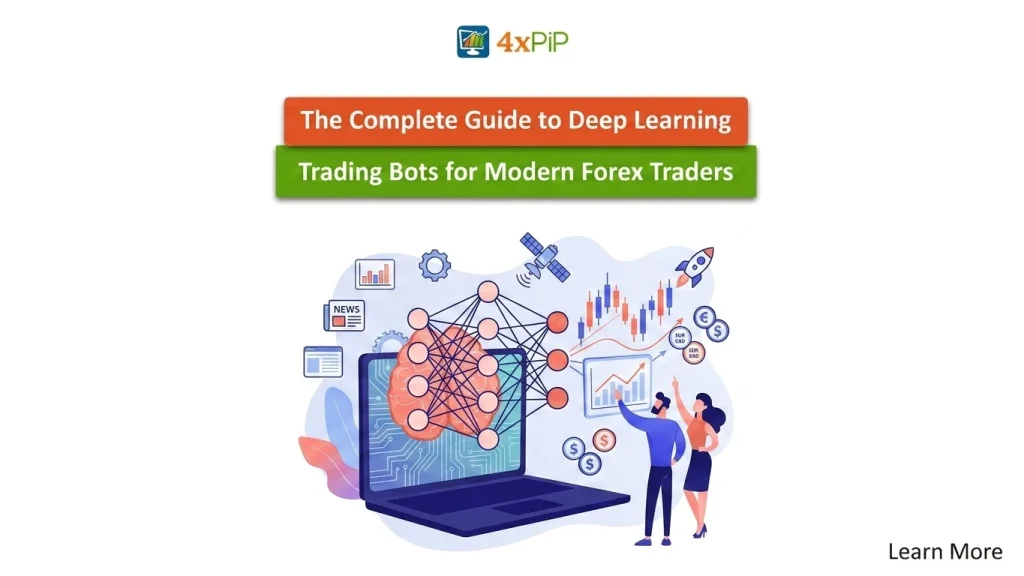
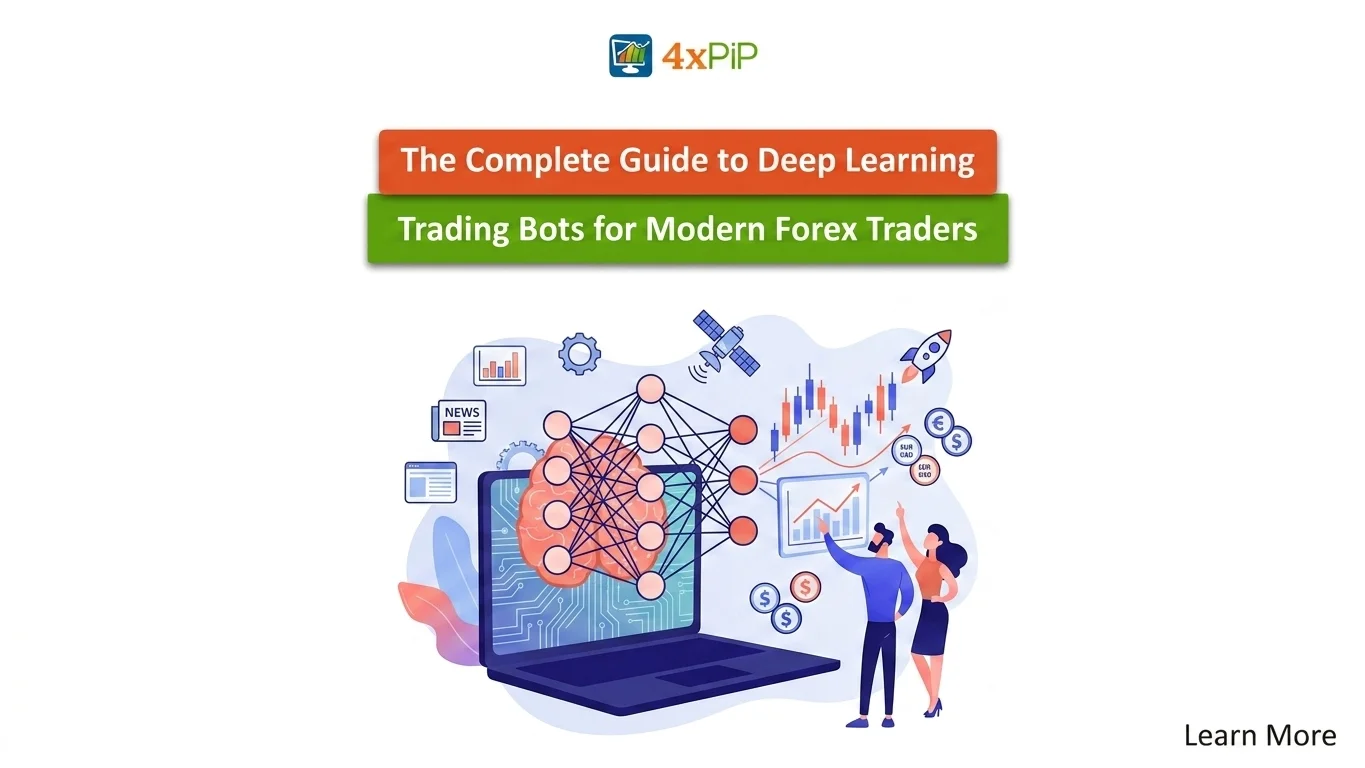
A Deep Learning Trading Bot is an advanced form of automated trading system that uses artificial neural networks and machine learning models to analyze market data, identify patterns, and execute trades with minimal human intervention. Unlike traditional Expert Advisors that rely on fixed rules, deep learning bots continuously “learn” from new market conditions, making them more adaptive in dynamic and volatile forex environments.
For traders who want smarter automation beyond rule-based systems, deep learning technology opens a new door. With 4xPip ( Forexpip ) expertise in AI driven automation, traders can transform complex strategies into intelligent trading systems that evolve with the market while maintaining disciplined execution and risk control.
What is a Deep Learning Trading Bot and Why Does It Matters?
A Deep Learning Trading Bot is an AI-powered system that mimics human, like decision making using layers of neural networks. Instead of strictly following pre-coded instructions, it studies historical and real-time market data to predict price movements and generate trading signals.
These bots are especially powerful in forex markets where price behavior is influenced by countless unpredictable factors such as liquidity shifts, news events, and institutional trading activity.Because of these features, traders using platforms like MetaTrader 4 and MetaTrader 5 are increasingly integrating AI models into their trading workflows through custom built solutions.
How Deep Learning Trading Bots Work in Real Market Conditions
The bot first collects historical market data and processes it into structured input features. These features are then fed into a neural network, which identifies hidden relationships between price movements. Once trained, the model begins predicting potential market directions and generating trade signals in real time.
Unlike traditional systems, the bot continuously updates its learning model as new data arrives, improving prediction accuracy over time.
A simplified workflow looks like this:
- Data collection from forex charts and indicators
- Feature engineering and normalization
- Neural network training and validation
- Signal generation based on probability outputs
- Automated trade execution and monitoring
This combination of AI prediction and automated execution allows traders to operate in fast moving markets without emotional interference.
Core Components of a Deep Learning Trading Bot
A fully functional deep learning trading system is not just a neural network, it is a combination of multiple interconnected modules that work together to ensure accuracy and stability.
The most important components include:
- Data Processing Engine
This module collects and cleans raw market data before feeding it into the model. High quality data directly impacts prediction accuracy. - Neural Network Model
This is the “brain” of the system. It identifies patterns in price movements using deep layers of computation. - Feature Engineering Layer
Here, raw data is transformed into meaningful inputs such as trend strength, volatility indexes, and momentum signals. - Risk Management System
This ensures capital protection through controlled lot sizing, stop loss placement, and exposure limits. - Execution Engine
This module connects the AI signals with trading platforms and executes orders instantly with minimal latency. Together, these components create a smart ecosystem that enables real time decision making with reduced manual involvement.
Advantages and Limitations of Deep Learning Trading Bots
Deep learning bots offer a significant technological edge over traditional algorithmic trading systems, but they also come with their own challenges.
On the positive side, they provide high adaptability, improved prediction accuracy over time, and the ability to analyze complex market structures that are difficult for rule-based systems to detect. They also reduce emotional trading and allow 24/7 market monitoring.
However, there are limitations traders should understand:
- High computational requirements for training models
- Risk of overfitting on historical data
- Dependency on quality and quantity of data
- Complexity in debugging and optimization
- Occasional unpredictability during extreme market events
Despite these challenges, when properly designed and maintained, deep learning trading bots can significantly enhance trading performance and consistency.
Building a Deep Learning Trading Bot with 4xPip
Developing an AI driven trading system requires both trading expertise and technical machine learning knowledge. This is where 4xPip ( Forexpip ) bridges the gap by converting trading strategies into fully functional AI powered bots.
The development process begins with strategy analysis, where traders share their entry rules, risk preferences, and market approach. The development team then translates this logic into a machine learning framework designed for forex automation.
The workflow typically includes:
- Strategy requirement gathering
- Data preparation and model selection
- Neural network training and testing
- Backtesting on historical market conditions
- Optimization for real-time execution
- Deployment on trading platforms
Once completed, the final bot is integrated with platforms like MetaTrader 4 or MetaTrader 5 for live trading. 4xPip ensures that the delivered system is fully optimized, secure, and aligned with the trader’s strategy while keeping proprietary logic confidential.
Challenges in Deep Learning Trading Bot Development
Even though AI trading systems are powerful, they require careful design and continuous maintenance to perform effectively in real world conditions.
Some of the most common challenges include:
- Overfitting to historical data
- Delayed responses in fast-moving markets
- Model degradation over time
- Difficulty in interpreting neural network decisions
- High dependency on clean and structured data
To overcome these issues, developers follow strict engineering practices such as regular retraining, performance validation, and stress testing under different market conditions.
Best practices include:
- Continuous model retraining with fresh data
- Strong risk management integration
- Real time performance monitoring
- Hybrid strategies combining AI and technical indicators
- Regular system updates and optimization
These practices ensure that the trading bot remains reliable even during changing market conditions.
Performance Evaluation and Continuous Optimization
Evaluating a deep learning trading bot goes beyond simple profit tracking. It requires analyzing multiple performance metrics that reflect both profitability and stability.Important evaluation metrics include win rate, drawdown levels, profit factor, and risk-adjusted returns. These indicators help determine how efficiently the bot performs under different market conditions.
At 4xPip ( Forexpip ), every AI trading system undergoes rigorous testing before deployment. This includes simulated trading, forward testing, and stress testing across different market cycles to ensure consistent behavior. Optimization is not a one-time process, it is continuous. Over time, traders can refine their bots by updating datasets, adjusting model parameters, and improving feature selection. This ensures that the system evolves alongside the market rather than becoming outdated.
Summary
Deep learning trading bots represent the next generation of algorithmic trading. By combining artificial intelligence with financial market data, these systems offer a smarter, more adaptive approach to forex trading. They reduce emotional bias, improve decision-making speed, and allow traders to operate with greater efficiency.
With 4xPip ( Forexpip ) AI driven development expertise, traders can turn their strategies into powerful deep learning systems that work continuously in real market conditions. From data modeling to execution and optimization, every step is handled with precision, ensuring a professional grade trading solution built for long term performance.
4xPip Email Address: [email protected]
4xPip Telegram: https://t.me/pip_4x
4xPip Whatsapp: https://api.whatsapp.com/send/?phone=18382131588
FAQs
1. What is a Deep Learning Trading Bot in forex trading?
A Deep Learning Trading Bot is an AI-based system that analyzes market data using neural networks and executes trades automatically based on learned patterns rather than fixed rules. It adapts over time as it processes new market information.
2. How is a deep learning trading bot different from a normal Forex EA?
A normal EA follows fixed programmed rules, while a deep learning bot learns from historical and real-time data. This makes it more flexible and adaptive to changing market conditions.
3. Do I need coding knowledge to use a deep learning trading bot?
No, you don’t need coding skills. With 4xPip, traders only provide their strategy, and the development team converts it into a fully functional AI trading system.
4. Can deep learning bots work on MetaTrader platforms?
Yes, these bots can be integrated with platforms like MetaTrader 4 and MetaTrader 5 for automated trade execution.
5. Are deep learning trading bots profitable?
Profitability depends on strategy quality, data accuracy, and market conditions. While AI improves decision-making, no bot guarantees fixed profits in forex trading.
6. What data does a deep learning trading bot use?
It uses historical price data, indicators, volume trends, volatility patterns, and sometimes macroeconomic signals to predict market movements.
7. How does risk management work in these bots?
Risk management is built into the system through stop loss, take profit, lot sizing, and drawdown control to protect trading capital during market fluctuations.
8. Can the bot adapt to changing market conditions?
Yes, deep learning models are designed to update and improve over time as they process new market data, making them more adaptive than traditional systems.
9. What are the main risks of using AI trading bots?
Key risks include overfitting, poor data quality, unexpected market volatility, and model performance degradation if not regularly updated.
10. Can I update or improve my trading bot later?
Yes, with 4xPip support, traders can continuously optimize their bots by updating strategies, improving models, and adding new features as markets evolve.