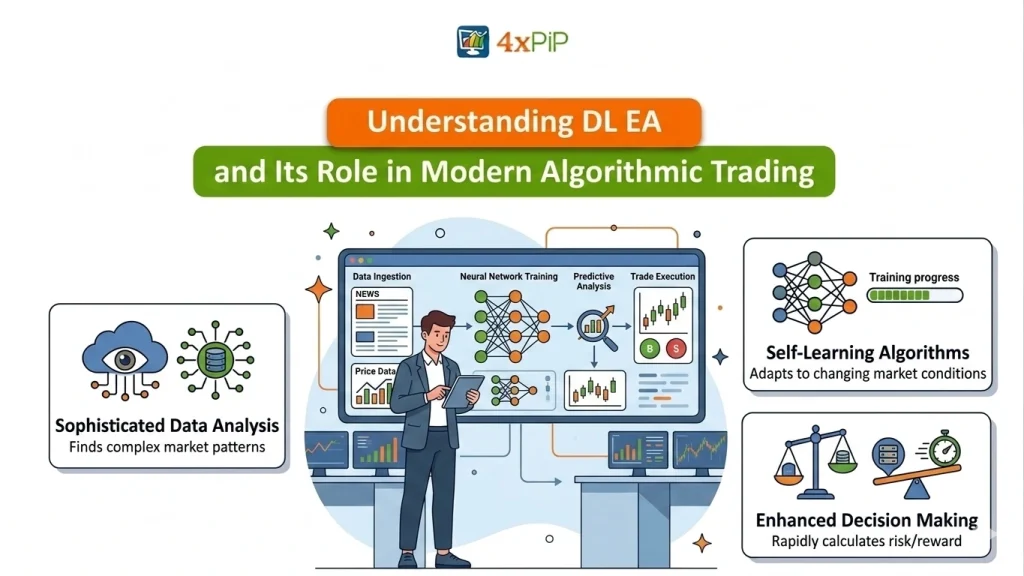
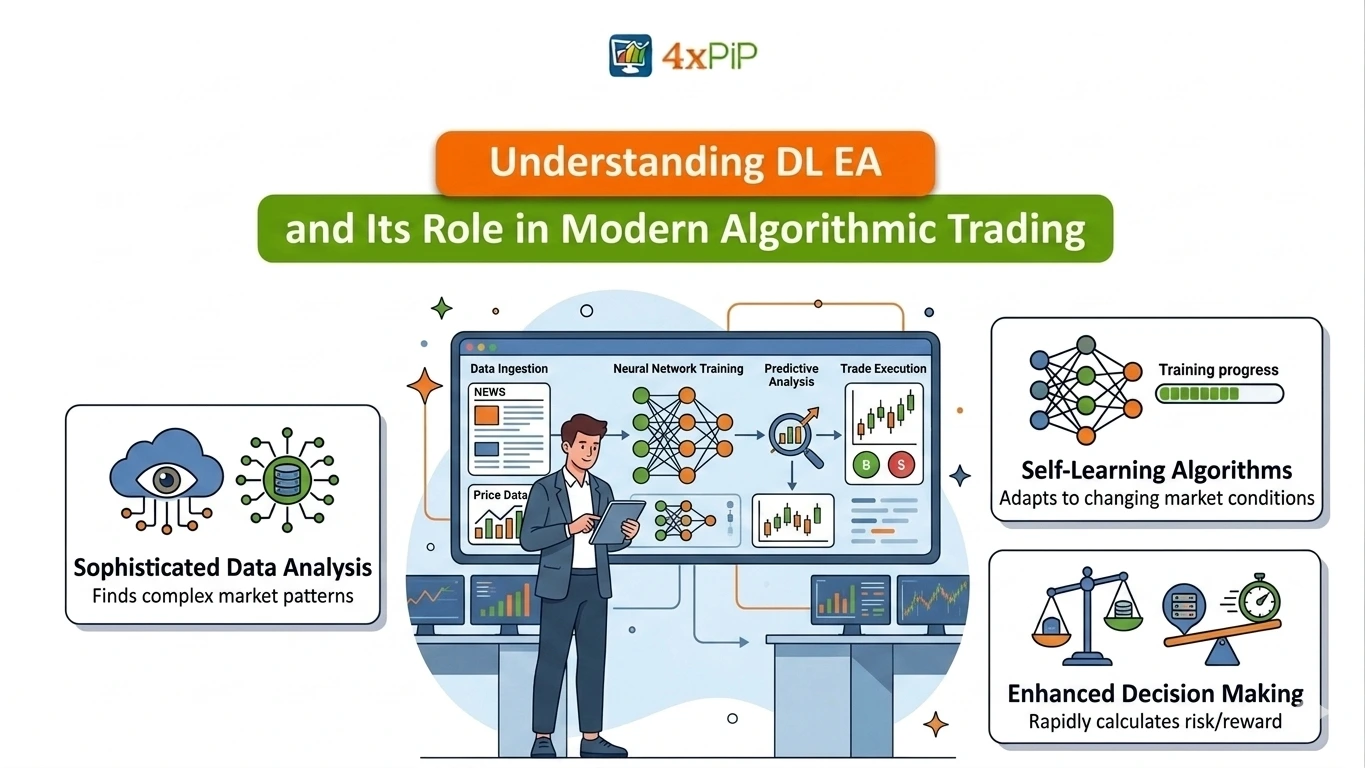
A Deep Learning Expert Advisor is an advanced form of automated trading system that combines deep learning models with MetaTrader execution to analyze market data and place trades without manual intervention. In the context of 4xPip Artificial Intelligence EA development, the Expert Advisor is trained using 10+ years of historical market data, where Machine Learning, Deep Learning, and Reinforcement Learning models process OHLCV candle data, technical indicators, and News Events to identify patterns such as trends, reversals, and market imbalances for automated Buy/Sell decisions.
Artificial intelligence and machine learning are now central to modern algorithmic trading because they allow systems to adapt beyond fixed-rule strategies. At 4xPip, the Developer team builds AI-based trading systems that continuously learn from evolving market conditions, combining candlestick behavior, indicators like RSI and MACD, and news-driven volatility analysis. This shift is driving traders and EA sellers to explore DL EAs for more market analysis, improved trade execution logic, and data-driven decision-making that aligns with real-time and historical market behavior.
What Is a DL EA and How Does It Work?
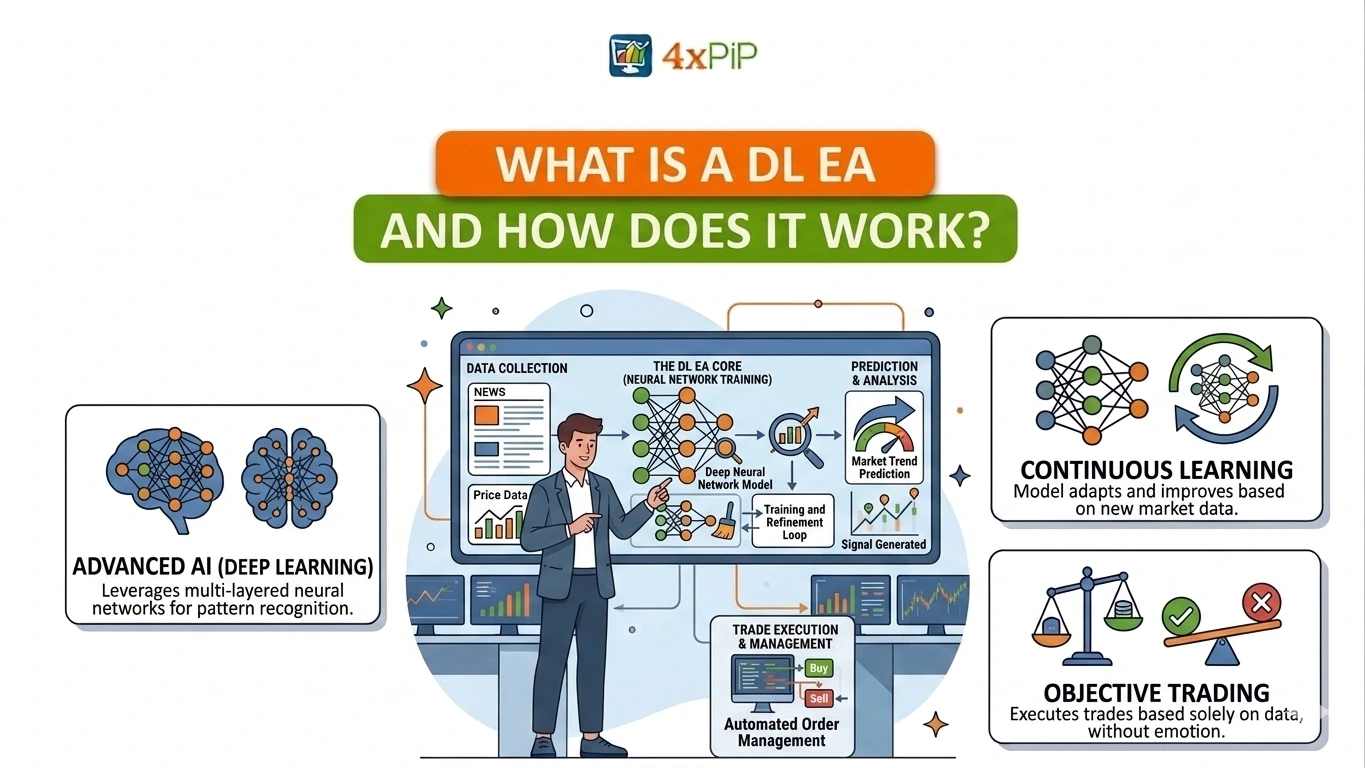
A Deep Learning Expert Advisor is an automated trading system built on neural network architecture that processes market data to generate trading decisions. In 4xPip Artificial Intelligence EA development, the Bot is designed using Machine Learning, Deep Learning, and Reinforcement Learning models, trained on 10+ years of historical market data including OHLCV candles, technical indicators, and News Events. This allows the system to identify complex market patterns such as trends, reversals, supply-demand zones, and volatility shifts.
Neural networks process both historical and real-time market data by converting inputs like price action, indicators (RSI, MACD, Bollinger Bands), and volume into weighted signals across multiple layers. In our 4xPip DL EA framework, the developer structures this flow so the model continuously learns from new candle formations, improving prediction quality over time. The workflow starts with data ingestion, followed by pattern recognition and signal generation, and ends with automated execution on MetaTrader, where the EA places Buy / Sell trades and dynamically sets Stop Loss and Take Profit levels based on predicted market probability.
Key Technologies Behind Deep Learning Expert Advisors
Deep Learning Expert Advisors rely on a combination of Machine Learning, Deep Learning , and Reinforcement Learning algorithms that process trading data to generate automated Buy/Sell decisions. In 4xPip development, the developer integrates neural networks that learn from 10+ years of historical market data, including OHLCV candles, technical indicators, and News Events, enabling the system to detect high-probability trading patterns across multiple currency pairs and timeframes.
The performance of a DL EA depends heavily on data quality, where large datasets undergo preprocessing such as normalization, feature extraction, and indicator transformation (RSI, MACD, ATR, Bollinger Bands). At 4xPip, this dataset is used to train models like LSTM, CNN, and Transformers, ensuring the Expert Advisor can adapt to different market conditions. High-performance computing infrastructure and cloud-based deployment systems like ONNX, Hugging Face, or local servers support real-time inference, allowing MetaTrader execution with low latency and stable trade execution across unstable market environments.
How DL EAs Differ from Traditional Rule-Based Trading Systems
Rule-based Expert Advisors operate on fixed conditions like predefined indicator thresholds, meaning trade decisions remain static once coded. DL EAs built by us at 4xPip use adaptive neural networks and ML pipelines that continuously learn from 10+ years of market data, allowing the EA to adjust logic dynamically instead of relying on rigid rules. This shift enables recognition of deeper market structures such as multi-timeframe momentum shifts, candlestick sequences, and volatility behavior that fixed systems cannot model.
Within our DL EA development process, the developer team trains models on large-scale datasets combining OHLCV data, technical indicators, and News Events to uncover hidden correlations between price movements and external market drivers. Traditional systems struggle in changing conditions, while DL EAs improve decision-making using evolving weights and Reinforcement Learning feedback loops, though they require higher computational resources and careful model validation before deployment on MetaTrader.
Common Applications of DL EAs in Algorithmic Trading
DL EAs developed by 4xPip are applied in algorithmic trading for trend prediction, pattern recognition, and multi-asset forecasting by processing 10+ years of OHLCV data alongside technical indicators and News Events. Unlike static systems, the Expert Advisor continuously learns from candlestick sequences, volatility shifts, and market structure changes to generate forward-looking price expectations instead of reacting only to fixed signals.
In real trading use cases, these DL EAs help identify precise entry and exit zones across Forex, Gold, indices, and crypto by combining Deep Learning models like LSTM and CNN with real-time indicator inputs. Within our DL EA framework, we integrate risk-aware logic that supports automated Stop Loss and Take Profit optimization, while portfolio-level models assist in balancing exposure across multiple currency pairs and market conditions to maintain controlled drawdown and stable performance.
Benefits and Challenges of Using DL EAs
DL EAs deliver strong advantages in automation, continuous monitoring, and data-driven execution, where every decision is shaped by trained patterns across 10+ years of historical market behavior. Within our DL EA framework at 4xPip, a user provides a Strategy, and the developer converts it into an EA for MetaTrader, ensuring execution across multiple asset classes with adaptive learning from candlestick patterns, technical indicators, and News Events.
Challenges appear when models become overly complex, risk overfitting, or depend heavily on data quality from OHLCV, indicators, and news feeds, which can distort predictions if not properly structured. This is why continuous validation, backtesting, and model retraining are essential in our DL EA development cycle, ensuring the Expert Advisor remains aligned with evolving market behavior and maintains stable performance across changing market conditions.
The Future Role of DL EAs in Modern Algorithmic Trading
The future of DL EAs is strongly tied to advances in transformer-based models, reinforcement learning, and adaptive neural architectures that continuously refine trading decisions using expanding historical datasets and live market feedback. Within our DL Expert Advisors ecosystem at 4xPip, a user defines the Strategy while the programmer builds the Expert Advisor that can evolve across MetaTrader, integrating deeper predictive layers that improve recognition of candlestick patterns, market gaps, and multi-timeframe behavior.
DL EAs are also moving toward tighter integration with alternative data sources such as economic news flows, sentiment signals, and high-frequency market feeds, allowing faster adaptation to real-time volatility. As these systems evolve, the Source code and underlying AI models require disciplined validation, retraining, and performance monitoring, ensuring the Expert Advisor continues to operate reliably across shifting market conditions while maintaining consistency in execution quality.
Summary
A Deep Learning Expert Advisor is an advanced automated trading system that uses neural networks and AI-driven models to analyze market behavior and execute trades without manual input. Unlike traditional rule-based systems, DL EAs process large-scale historical and real-time datasets to detect complex patterns including trends, reversals, and volatility shifts. In modern algorithmic trading, these systems integrate Machine Learning, Deep Learning, and Reinforcement Learning to continuously refine decision-making based on evolving market conditions.
In frameworks like those developed by 4xPip, DL EAs are trained on extensive historical datasets spanning over a decade, enabling them to learn from candlestick structures, indicator signals (such as RSI and MACD), and macroeconomic influences. The result is a dynamic trading system capable of adapting its logic instead of relying on fixed conditions. While these systems offer improved analytical depth, automation, and multi-asset capability, they also require strong validation, backtesting, and ongoing retraining to maintain reliability. As AI technologies continue to evolve, DL EAs are expected to play a more significant role in predictive trading, real-time execution, and adaptive risk management across global financial markets.
4xPip Email Address: [email protected]
4xPip Telegram: https://t.me/pip_4x
4xPip Whatsapp: https://api.whatsapp.com/send/?phone=18382131588
FAQs
- What is a Deep Learning Expert Advisor (DL EA)?
A DL EA is an AI-powered automated trading system that uses neural networks to analyze financial markets and generate Buy or Sell signals. It goes beyond rule-based automation by learning patterns from large datasets and adapting its trading logic over time. - How does a DL EA work in algorithmic trading?
A DL EA processes market data such as price charts, indicators, and trading volume through layered neural networks. It identifies patterns, generates predictive signals, and executes trades automatically through platforms like MetaTrader with built-in risk parameters. - How is a DL EA different from a traditional Expert Advisor?
Traditional Expert Advisors follow fixed rules and static conditions, while DL EAs continuously learn from historical and live data. This allows DL EAs to adjust their strategies dynamically instead of relying on pre-programmed logic. - What type of data is used to train DL EAs?
DL EAs are trained using OHLCV candle data, technical indicators like RSI and MACD, and news or economic events. This combination helps the model understand both technical and fundamental market behavior. - Which AI models are commonly used in DL EAs?
Common models include LSTM for time-series prediction, CNN for pattern recognition, and Transformer-based architectures for advanced sequence analysis. These models help capture both short-term fluctuations and long-term trends. - What role does Reinforcement Learning play in DL EAs?
Reinforcement Learning allows the system to improve through feedback from past trades. The model learns which actions lead to better outcomes and gradually optimizes its trading decisions over time. - Where are DL EAs typically applied in trading?
DL EAs are used in Forex, commodities like gold, indices, and cryptocurrency markets. They are especially useful for trend prediction, volatility analysis, and identifying high-probability entry and exit points. - How do DL EAs manage risk in trading?
They integrate automated risk controls such as dynamic Stop Loss and Take Profit settings based on market conditions. Some systems also adjust exposure across multiple assets to reduce overall portfolio risk. - What are the main benefits and challenges of DL EAs?
DL EAs offer advanced automation, adaptability, and data-driven decision-making. However, they require high-quality data, strong computing resources, and careful backtesting to avoid issues like overfitting or unstable performance. - What is the future of DL EAs in trading?
The future of DL EAs lies in more advanced AI models, real-time learning systems, and integration with sentiment and economic data. These improvements will make trading systems more adaptive, predictive, and efficient in changing market conditions.